



Access to Work applicants may be told to wait up to 37 weeks, so knowing what to do about delays to your application can help you plan practical support in the meantime. You can follow up with the Access to Work helpline, keep a record of your application and any updates, and talk with your employer about reasonable adjustments that could help you work while you wait; under the Equality Act 2010, employers must make reasonable adjustments for disabled people. This guide explains how to apply for an Access to Work grant, what to do if there’s a delay, and how to consider employer adjustments alongside support that may go beyond those legal duties.
Key Takeaways
- Apply before committing to support costs, as Access to Work funding starts from the date you submit your application.
- Keep your application details and updates together so you can follow up clearly if you’re waiting for a response.
- Talk with your employer about practical adjustments that could help you work while your application is being considered.
- Consider Access to Work support or workplace training when you need help identifying useful adjustments and putting them into practice.
Access to Work support and employer reasonable adjustments
Access to Work can fund practical support for barriers linked to a disability or health condition. Employers also have separate responsibilities to make reasonable adjustments.
Interim support while waiting
Interim support means practical help arranged while your Access to Work assessment is pending. A wait need not stop you and your employer from addressing immediate barriers. After you apply, your employer can buy specialist equipment and may be able to recover the cost following the assessment. Discuss what could help now, such as assistive equipment or a change to your working arrangements.
Backdated funding for costs during delays
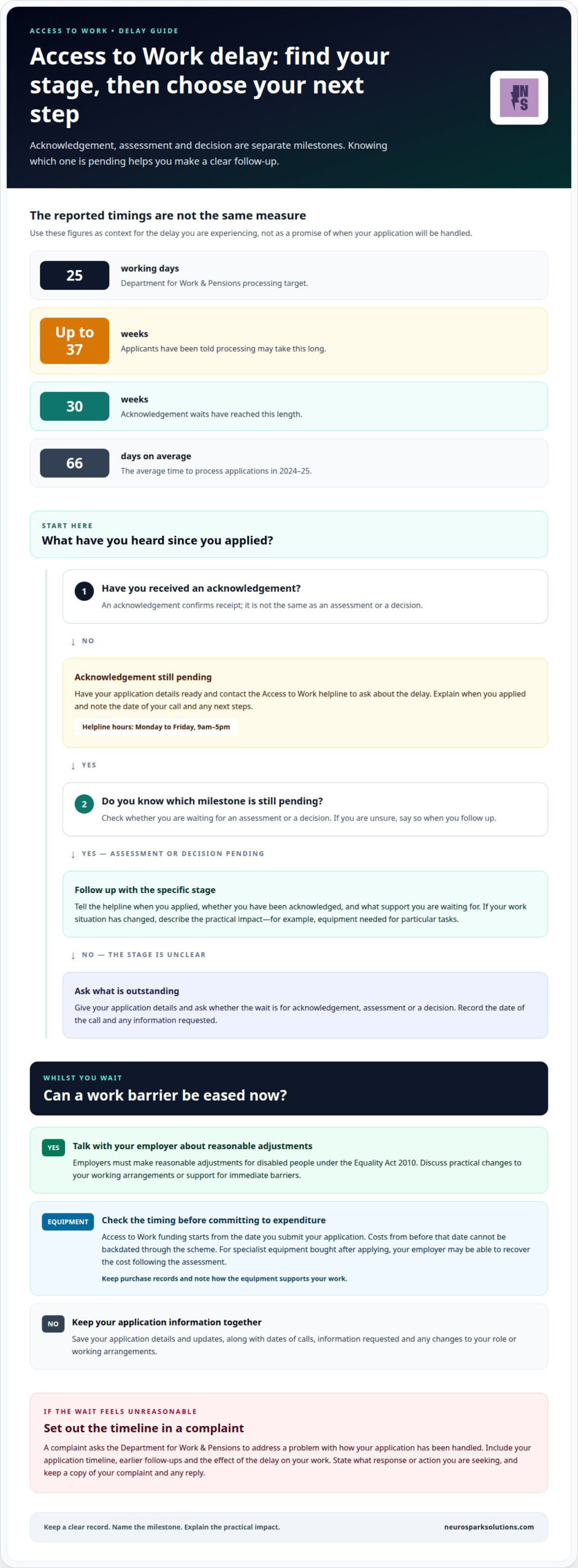
Access to Work funding starts on the date you submit your application, so costs from before that date cannot be backdated through the scheme. Apply before committing to expenditure. For specialist equipment bought after you apply, your employer may be able to recover the cost following the assessment. Keep purchase records and note how the equipment supports your work.
Access to Work is intended to fund support beyond adjustments an employer is legally required to make. Under the Equality Act 2010, employers must make reasonable adjustments for disabled people, and Access to Work can advise whether a workplace change falls within that duty. Discuss practical adjustments directly with your employer while the application is pending.
According to the Department for Work & Pensions, in England, Wales and Scotland, you must be over 16 years old to qualify for Access to Work. Eligible support can include a support worker, assistive software or travel support when public transport cannot be used.
Support workers can help remove barriers to completing the core tasks of a role. For employers, Access to Work payments for a support worker usually take 10 working days.
Support can also cover communication at job interviews. For example, a deaf or hard-of-hearing applicant may need a BSL interpreter or lipspeaker; someone with a health condition or learning difficulty may need other communication support.
Reported delays processing applications and renewals
Access to Work applications and renewals have faced reported processing delays. Identifying the stage that is waiting helps you choose a useful follow-up.
Reported processing delays
Processing delays mean applications take longer than the Department for Work & Pensions’ target of 25 working days. This can affect plans for disability-related support, such as workplace equipment or support workers. Applicants have been told processing may take up to 37 weeks, while acknowledgement waits have reached 30 weeks. The Department for Work & Pensions took an average of 66 days to process applications in 2024-25. Acknowledgement and decision are separate milestones, so note which one you’re waiting for.
Differences in processing times
Published figures describe overall processing, not a dependable comparison between UK regions or support types. They do not show that a learning-related application, mental health support request or renewal will move faster than another. If you’re considering access to work application delays and what to do next, first identify whether you’re waiting for acknowledgement, assessment or a decision. This distinction helps you explain the delay clearly when following up.
Contacting the helpline about delays
The Access to Work helpline is the route for asking about a delayed application. It’s available Monday to Friday, from 9am to 5pm. Have your application details ready and explain when you applied, whether you’ve received an acknowledgement, and what support you’re waiting for. If your work situation has changed, describe the practical impact, such as equipment needed for specific tasks. Note the date of your call and any next steps given.
Complaining about unreasonable delays
A complaint asks the Department for Work & Pensions to address a problem with how your application has been handled. The Department received 800 Access to Work complaints in the first six months of 2025-26. If you’re working out access to work application delays and what to do about an unreasonable wait, set out your application timeline, earlier follow-ups and the effect on your work. State what response or action you’re seeking, and keep a copy of your complaint and any reply.
Applying for an Access to Work grant
A clear application explains how your disability or health condition affects your work and what practical support could help. Describe the work tasks affected, the barriers you face and how the requested support relates to those tasks. For example, explain how a support worker could assist or how equipment would help you complete a specific task. This gives the assessment a clearer picture of your needs at work.
Useful evidence can include details of your role, workplace, working arrangements and confirmed start date. Where relevant, explain how a specific barrier affects your day-to-day duties rather than relying on a general description. A manager’s account of work tasks or a workplace survey may add context, as long as it reflects your situation. This information can clarify your request, but it does not set a processing date.
If you have a written job offer, you can apply up to six weeks before starting work. In England and Wales, your application is a priority if you’re due to start within four weeks. Include your confirmed start date and role details to make the urgency clear. If you’re unsure what to do about Access to Work application delays, identify the stage you’re waiting for and keep your application details ready for a follow-up.
Apply before committing to support expenditure: funding is valid only from the date you submit your application. In England and Wales, call the helpline if you haven’t heard about your application within a week. Record when you applied and any information requested. If you’re deciding what to do about delays to an Access to Work application, explain any changes to your role or working arrangements when you follow up. This helps ensure the information reflects your current needs.
Backlogs of applications awaiting decisions
A large queue can leave applicants waiting even after they have submitted the required information. Backlog figures help explain why following up may not produce an immediate decision.
Checking an application’s status
Checking your application’s status means asking the Department for Work & Pensions which stage it has reached. This can help you distinguish an application awaiting review from one that needs further action. Contact Access to Work with your application details and submission date, and ask whether your application has been received, acknowledged or assessed. Note the response and any next steps so you can track progress without relying on memory.
Following up when there is no response
If you haven’t heard back, follow up with Access to Work and explain how long you’ve been waiting. The government’s reported backlog was around 66,000 cases in March 2026, and the Department for Work & Pensions expects clearing it to take at least 18 months. These figures help set expectations, but don’t tell you where your individual application sits. Record each contact and any update you receive.
The backlog has grown over time. There were 21,700 outstanding cases in March 2022 and 62,100 applications awaiting a decision in March 2025. In January, the government added 55 caseworkers to help address the queue. Additional staff may support processing, but the overall workload still affects how quickly cases move. Applicants should keep their contact details up to date and respond promptly if Access to Work requests information.
Payment requests also form a separate part of the pressure: 31,700 were outstanding in March 2025. An application awaiting a decision and an approved grant awaiting payment are different stages, so state clearly which applies when you follow up. The government announced further recruitment to help clear the backlog by September 2027. If waiting affects the support you can access at work, continue discussing practical adjustments with your employer while your case progresses.
Neuro-Sparks training solutions: Workplace training
Neuro-Sparks training solutions can help you turn workplace barriers into practical support while an Access to Work decision is pending. Its workplace training helps teams build understanding and consider how working practices affect people’s day-to-day tasks.
For individuals, Access to Work support can help you understand the scheme and the workplace barriers you want to address. For employers and managers, HR team support can bring workplace needs into team discussions and inform practical adjustments. These services can help you plan support alongside an application instead of waiting to discuss workplace needs.
If you’d like support with workplace training or Access to Work, contact Neuro-Sparks training solutions to discuss what would be useful for you.
Make the next step manageable
Choose one workplace barrier to address first, then write down a change that could make it easier to manage. For example, you might ask your manager to agree how priorities are shared or new instructions confirmed. A specific request gives you something practical to discuss and a clear way to decide whether it helps.
If you’re considering what to do about an Access to Work application delay, focus on the support that would make the greatest difference to your working day. Agree with your manager when to review the arrangement, and note what is working or remains difficult. Small, clear steps can help you keep moving while your application progresses. The team brings Access to Work expertise; contact them to discuss support.
Frequently Asked Questions
How long does an Access to Work application usually take to process in the UK?
There isn’t one reliable timescale that applies to every application and renewal. If you already receive a grant, check its end date and plan ahead: an Access to Work grant usually lasts up to three years, and the Department for Work & Pensions contacts recipients 12 weeks before support is due to end. That gives you a chance to prepare for a renewal rather than wait until existing support is ending.
Can I start work or pay for adjustments while waiting for an Access to Work decision?
Your employment start arrangements are separate from the grant decision, so discuss your planned start with your employer. If you work from home some or all of the time, your home can count as your workplace for Access to Work purposes. This may help you describe where a barrier arises, such as difficulty using equipment or completing tasks in your usual workspace.
What support can employers provide while an Access to Work application is pending?
Employers can make day-to-day work clearer while you wait. For example, they could share meeting agendas in advance, provide written instructions or offer a quieter place for focused tasks. You and your manager can identify which change addresses a specific barrier, then agree how to communicate if it is not helping. This gives you a practical way to refine support around your work rather than relying on a general plan.