



Neurodivergent business coaching offers structured, practical support to help you make business decisions, build on your strengths and find ways of working that suit you. If you’re an adult with ADHD or autism, coaching can help you navigate everyday business challenges without treating your neurodivergence as something to fix. You’ll learn what coaching can involve, how neuro-affirming, evidence-informed support may help, and what to consider when choosing a coach.
Key Takeaways
- Understand how coaching can address the practical demands of running a business while respecting your way of thinking and working.
- Explore how support can be tailored to your experiences of ADHD or autism, rather than relying on assumptions or one-size-fits-all advice.
- Learn how coaching can help you recognise your strengths and approach doubts about your professional abilities with greater clarity.
- See how evidence-informed approaches and business coaching from Neuro-Sparks training solutions can support practical next steps.
Neuro-affirming support for neurodivergent business owners
Neuro-affirming support starts with your priorities, not assumptions about ADHD or autism. In business, that could mean finding practical ways to manage planning, communication or decisions.
Support with work and business challenges
Coaching can focus on a specific challenge, such as preparing for a senior meeting, prioritising client work or creating a sustainable routine. You and your coach can identify what has worked before, where difficulties arise and what practical change to try next. Reflecting on the results can help you refine your approach.
Support can also help people balance business responsibilities with family life. For example, a parent might explore how school routines affect their available work time. If you were diagnosed recently, coaching can help you connect new self-understanding with past work experiences, without treating your history as a problem to fix.
Coaching, ADHD coaching and business mentoring
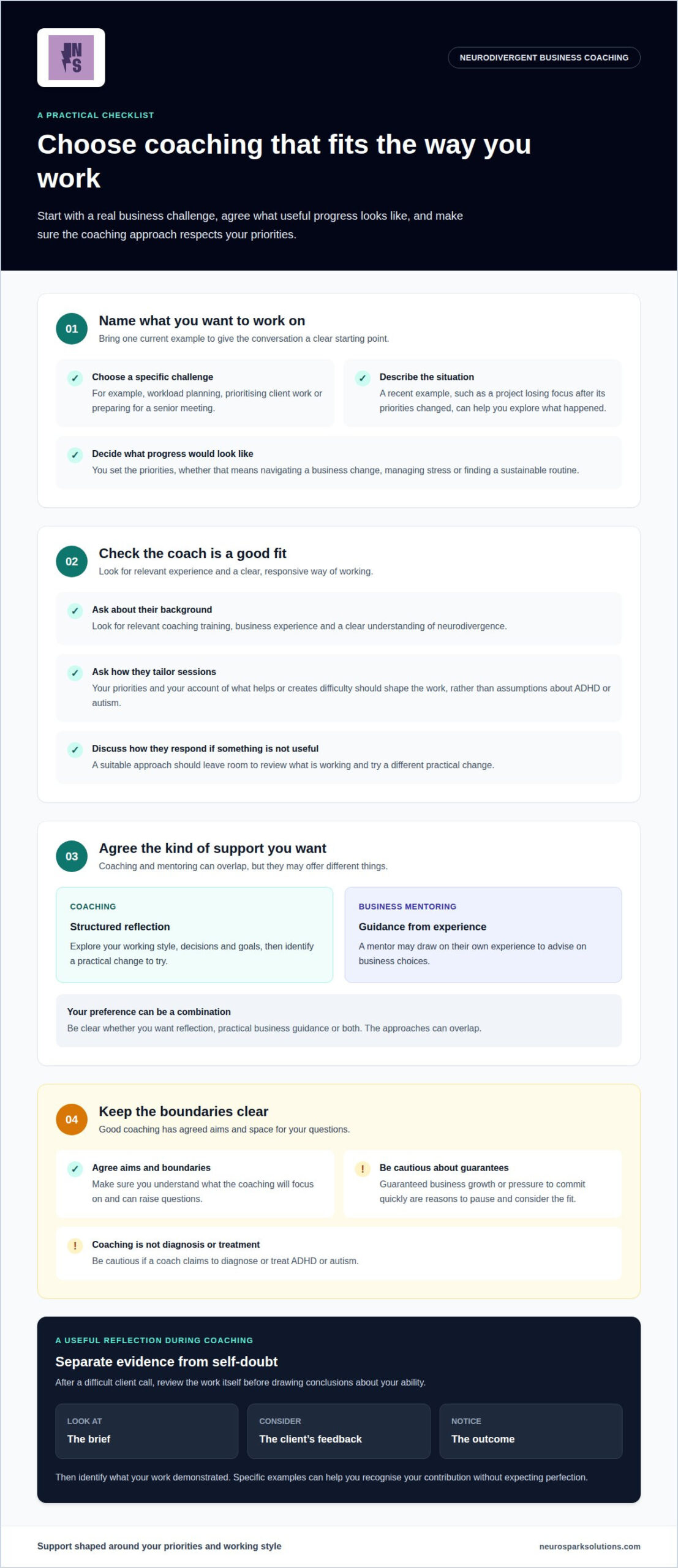
Neurodivergent business coaching can bring together ADHD or autism, business decisions, working styles and communication. ADHD coaching may focus on challenges associated with ADHD, while business mentoring often draws on a mentor’s experience to advise on business choices. The approaches can overlap. Consider whether you want structured reflection, practical business guidance or a combination of both.
Choosing a qualified business coach
In the UK, look for a coach with relevant coaching training, business experience and a clear understanding of neurodivergence. Ask how they tailor sessions to your goals and respond if an approach isn’t useful. For an initial session, bring one current challenge, such as workload planning, and consider what progress would look like.
Access to Work grants cover 100% of support costs for coaching and training, regardless of employer size. Access to Work support may help you understand how work-related support applies to your circumstances.
Be cautious if a coach promises guaranteed business growth, pressures you to commit quickly or claims to diagnose or treat ADHD or autism. Coaching should have clear boundaries, agreed aims and room for your questions.
Coaching for adults with ADHD and autism
Coaching for adults aged 18 years and above can focus on how ADHD or autism affects their working lives. You set the priorities, whether that means navigating a change in your business, managing stress or deciding what professional development matters most. Sessions should make room for your own account of what helps and what creates difficulty.
ADHD and autism are different, and people’s experiences vary. Someone with ADHD may want help maintaining focus across a changing workload, while an autistic person may want to explore how workplace expectations affect them. Some adults also have a specific learning difference, such as dyslexia. Coaching can focus on the practical effects of these experiences without assuming that one diagnosis tells the whole story.
For example, a business owner overwhelmed by competing commitments could explore which responsibilities fit their role and which might need a different approach. A coach can help them weigh options and decide what to try. A leader who finds networking stressful might consider ways to build professional relationships that feel manageable and genuine.
In the UK, coaches may bring business experience, knowledge of ADHD or autism, or experience supporting people with specific learning differences. Some have experience in more than one area. Their background matters because business decisions and personal working needs can overlap. A conversation about their experience can help you understand how they’ll keep the coaching relevant to your situation.
Before beginning, consider what you’d like to change in your working life. You could describe a recent situation, such as losing track of a project after its priorities changed. This gives you and the coach a clear example to explore. The aim is to support your development while respecting how you want to work, not to prescribe a standard routine.
Practical considerations may include who will guide the work and how you want to book it. Chris Talintyre has worked with 200+ SMEs across the technology, creative and social sectors, while Jo Gatford has more than 15 years of experience working with creative people across industries.
In the UK, employers with 50 to 249 employees may be liable for the first £500 of Access to Work support and 20% of eligible support costs up to £10,000.
Imposter syndrome and professional confidence
After a difficult client call, you might doubt your ability, even when you delivered the work well. Coaching can help you separate evidence from self-doubt. For example, you could review the brief, the client’s feedback and the outcome, then identify what your work demonstrated. Reflecting on specific achievements can support confidence without requiring you to be perfect before you feel you belong in business.
At work, confidence doesn’t have to mean masking or copying colleagues. A neurodivergent individual might prepare meeting notes in advance, request written actions or take a pause before answering. These are practical ways to communicate and function at work, not signs of lower ability. Coaching can help you decide which adjustments feel authentic and how to explain them to a colleague, client or team leader.
Stress can make progress harder to recognise. When you’re focused on delivering a launch, for instance, you might overlook the planning and decisions that made it possible. A coach can help you map the workload, notice early signs of strain and identify tasks that could be delayed, delegated or simplified. The aim is to find a sustainable way of working, not simply get through another demanding week.
Confidence also grows when you can name your contribution clearly. Before a review or pitch, note one example of a problem you solved, one strength you used and one result you helped deliver. A certified coach can support this reflection without setting an expectation that you should become more like someone else. For neurodivergent individuals, recognising effective working patterns can make it easier to discuss support and boundaries. Workplace training can also help colleagues understand communication needs, so confidence isn’t left entirely to the individual.
The programme includes continuous improvement, self-reflection and actionable skill development. The coach holds the ICF’s Professional Certified Coach (PCC) credential and the ILM Certificate in Enhanced Performance Strategies for Neuro-Differences in the Workplace.
Chris Talintyre has 5+ years of experience coaching neurodivergent entrepreneurs and professionals, and Liv Blaney has been coaching professionally since 2018. Applicants without a coaching qualification may be considered if they have at least 2 or 3 years of regular coaching practice.
Evidence-informed coaching approaches
Evidence-informed coaching turns discussion into practical actions and reviews what happens. You might choose a goal, such as making time for business planning each week. A coach can help identify what interrupts that time, test a change and review its effect. If the approach is difficult to maintain, you can adjust it rather than assume you have failed.
Useful sessions connect your experience with clear coaching practices, such as attentive listening, goal-setting and reflection. For example, you could agree how to recognise progress on a task that often stalls. In a later session, you can discuss what helped and what got in the way, giving you a clearer basis for choosing your next step.
A tailored approach should account for how you prefer to process information. You might find a short written summary easier to revisit than spoken instructions, or prefer to talk through a decision before recording it. Agreeing how to share information can make sessions more accessible and keep the focus on your priorities.
Consider how a coach explains their approach and responds to feedback. Ask how they adapt sessions if a strategy doesn’t suit you, or how they review agreed goals. A certificate may show relevant training, but it won’t tell you whether their style fits. Clear explanations and respect for your choices matter too.
If you’d like support shaped around your working needs, explore tailored neurodiversity coaching.
Neuro-Sparks training solutions: Business coaching
Neuro-Sparks training solutions offers business coaching to help you work through priorities, decisions and challenges in ways that suit your needs. It can be a useful next step when you want structured support to turn a broad concern, such as managing competing demands, into practical actions.
Coaching can sit alongside workplace training, assessments or HR team support when these address a related need. Access to Work may be able to help fund the support you need, with eligibility determined by the UK Department for Work and Pensions.
To explore whether business coaching fits your goals, contact Neuro-Sparks training solutions.
Choose a practical next step
You don’t need to map out every business challenge before seeking support. Start with the decision or work pattern that would make the biggest difference if it felt more manageable. This gives your neurodivergent business coaching a clear direction, while leaving room to adapt as your priorities change.
Neuro-Sparks training solutions can help you consider business coaching alongside workplace training, assessments or HR team support, depending on your needs. The team’s neurodiversity support can also help connect individual goals with practical workplace understanding. You remain central to decisions about what support is relevant and how you want to move forward.
If you’re ready to talk through a suitable next step, contact Neuro-Sparks training solutions. A clear starting point can make progress feel more manageable, one decision at a time.
Frequently Asked Questions
What is coaching?
Coaching is a collaborative process that helps you clarify a goal and decide how to work towards it. A coach asks questions, helps you consider options and supports you in turning ideas into practical actions. For example, you might work through a business decision and agree on a realistic next step that fits your priorities.
What support can UK neurodivergent business coaches offer for ADHD, autism or dyslexia?
Support can focus on your business or workplace needs, shaped around your experience of ADHD, autism or dyslexia. For instance, you might work through how to organise tasks, communicate with colleagues or plan a project. Neuro-Sparks training solutions also offers assessments and workplace training to address related support needs for individuals or teams.