



An employee with ADHD can be dismissed for threatening a colleague, but the employer must assess the conduct fairly and consider its disability-related responsibilities. In Hayes v Scania, an apprentice threatened to damage a colleague’s car after his lunch was tampered with. The tribunal accepted that ADHD had influenced his behaviour, but found that dismissal for the threats was fair and that ADHD did not remove his responsibility. For employers dealing with gross misconduct when an employee has ADHD, the key is to assess the seriousness of the behaviour alongside any connection to the employee’s disability.
It’s understandable to feel pulled between protecting colleagues and responding fairly to an employee’s needs. ADHD may help explain behaviour, but it doesn’t automatically excuse threats or make dismissal discriminatory. This article explains how the Equality Act 2010 and a fair disciplinary process apply, what the Scania case shows about threats and gross misconduct, and how adjustments and relevant evidence can inform a proportionate decision.
Key Takeaways
- Separate the seriousness of a threat from the question of whether ADHD may have influenced the behaviour.
- Use a fair disciplinary process and consider adjustments that help the employee take part meaningfully.
- Weigh the impact on colleagues, relevant evidence and possible alternatives before deciding whether dismissal is proportionate.
- Build managers’ understanding of neurodivergence so they can respond to conduct concerns with clarity and consistency.
Disability and ADHD: was it fair to dismiss an employee because he threatened a colleague who had ruined his lunch?
In Hayes v Scania, an apprentice threatened a colleague after finding that his lunch had been tampered with. The case shows why employers should examine the behaviour, its context and how the employee was treated at work.
Performance management and workplace treatment
Performance management addresses concerns about an employee’s work or conduct and helps clarify expectations. ADHD can affect organisation, prioritising, communication under stress or responses to busy environments, but these effects vary between people. Discuss specific examples with the employee, including what happened before the incident and what support may help. A conversation about ADHD can inform the response without assuming the diagnosis explains every action.
Workplace adjustments under the Equality Act
The Equality Act 2010 requires reasonable adjustments where a disabled employee is substantially disadvantaged by a workplace rule, practice or feature. Sections 20 and 21 set out duties relating to those adjustments. An employer’s knowledge of the disability and disadvantage matters. Consider practical changes to a disciplinary process, such as providing information in an accessible format or adjusting meeting arrangements, and discuss what would help the employee participate.
Neurodiversity and workplace conduct
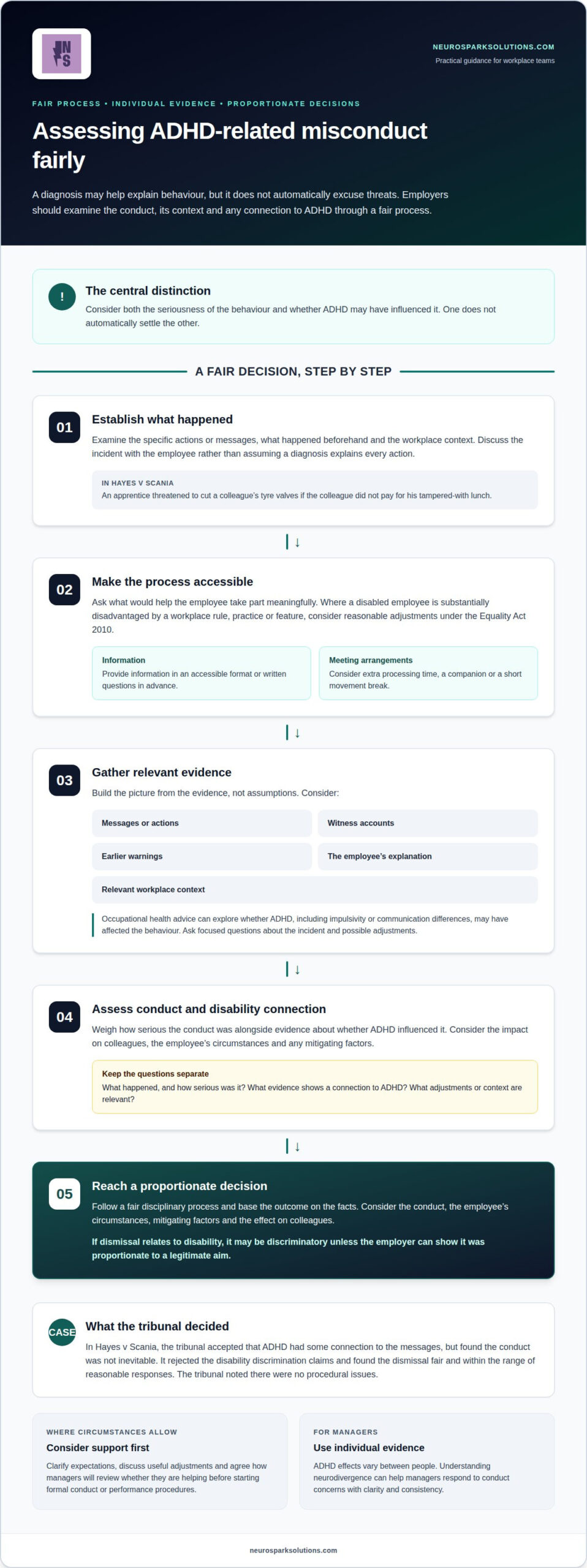
Neurodiversity can shape communication or behaviour, but it does not make threats an inevitable consequence of ADHD. In Hayes v Scania, the apprentice threatened to cut a colleague’s tyre valves if the colleague did not pay for his lunch. The tribunal accepted that ADHD had some connection to the messages, but found the conduct was not inevitable. It rejected his disability discrimination claims, showing why context and individual evidence matter.
If you are appealing, follow the employer’s stated procedure and deadline. Where appropriate, raise a grievance informally first, or formally if the issue is serious or remains unresolved. In most employment cases, the tribunal deadline is three months less one day, with at least one month after an Acas early conciliation certificate to lodge a claim.
Fair dismissal and the range of reasonable responses
A disciplinary decision should reflect the evidence, the employee’s circumstances and a fair process. Adjustments can help an employee with ADHD participate fully without preventing an investigation into serious conduct.
Reasonable adjustments during investigations
Adjustments change how an investigation or disciplinary meeting is conducted to reduce disability-related disadvantage. Ask the employee what would help, then consider practical changes to the information, meeting format or venue. For example, written questions in advance and extra processing time may help them give clear responses. A companion or short movement break may also make it easier to participate. An accessible process gives the employee a fair opportunity to explain what happened.
Support before formal procedures
Where circumstances allow, address workplace difficulties through support before starting formal conduct or performance procedures. Clarify expectations, discuss useful adjustments and agree how managers will review whether they are helping. If you’re accused of gross misconduct, respond to the allegations, share relevant context and explain any adjustments you need to participate. Ask for the process and meeting details in writing, and use the employer’s disciplinary procedure to understand how to respond or appeal.
Evidence and occupational health advice
Consider the messages or actions in question, witness accounts, earlier warnings, the employee’s explanation and relevant workplace context. Occupational health advice can explore whether ADHD may have affected the behaviour, including whether impulsivity or communication differences contributed. Ask focused questions about the incident and possible adjustments rather than relying on a general report. This evidence helps the decision-maker assess the conduct and any connection to ADHD.
Under the Acas Code of Practice, employers should follow a fair disciplinary process. The outcome should be proportionate to the conduct and based on the facts, including any mitigating circumstances and the effect on colleagues. In Hayes v Scania, the tribunal found the dismissal fair and within the range of reasonable responses, noting there were no procedural issues. A careful process supports equality while allowing employers to address serious misconduct.
ADHD-related misconduct and discrimination arising from disability
An ADHD diagnosis does not, by itself, determine whether a dismissal is fair or discriminatory. Employers must consider disability protection, any connection between the behaviour and ADHD, and the reasons for their decision.
An employer can dismiss for gross misconduct, but must assess the conduct fairly and consider the risk of discrimination. If the treatment is related to disability, it may be discriminatory unless the employer can show it was proportionate to a legitimate aim.
ADHD and Equality Act disability protection
The Equality Act 2010 protects disabled employees from discrimination at work and requires reasonable adjustments. This matters because ADHD-related effects may shape how an employee experiences workplace rules or disciplinary processes. Employers should consider the person’s needs and the disadvantage they face, rather than treating a diagnosis as proof of a particular behaviour or assuming it has no relevance.
The Equality Act disability test
The disability test considers the effect of an impairment on normal day-to-day activities. According to UK Parliament, that adverse effect must have lasted, or be likely to last, at least 12 months. A formal ADHD diagnosis is not essential to the test; the impact on daily life matters. This helps employers focus on the employee’s experience and any support needed.
Discrimination arising from disability
Section 15 of the Equality Act 2010 concerns unfavourable treatment because of something arising from a person’s disability. For example, an employer may discipline an employee for conduct caused or influenced by ADHD. The employer should consider the connection carefully, including relevant evidence and the employee’s explanation. A conversation about that connection can help distinguish individual circumstances from assumptions about ADHD.
Proportionality in disability discrimination
Proportionality means assessing whether a decision is a fair and necessary way to meet a legitimate aim, such as protecting colleagues from threats. Consider the seriousness of the conduct, its effect on others, any mitigating circumstances and whether a less severe response could achieve the same aim. This helps employers address safety concerns without overlooking disability-related factors or reaching an unfair decision.
Gross misconduct and threats towards a colleague
When dealing with gross misconduct involving an employee with ADHD, assess the specific threat and its impact at work. A serious allegation calls for a clear distinction between upsetting language, an expression of anger and words that could reasonably make a colleague fear for their safety or property.
What counts as gross misconduct
Gross misconduct describes conduct an employer considers serious enough to potentially justify dismissal under its disciplinary rules. The label should follow the evidence, not replace an assessment of it. Consider the words or actions, who received them, whether they were repeated and whether the employee had a realistic opportunity to carry them out. These details help explain whether the conduct damaged trust or made working relationships difficult to continue.
Threats towards a colleague
A threat can affect more than the person it targets. Colleagues who witness it may feel unsafe, avoid shared spaces or lose confidence that concerns will be taken seriously. Consider what the recipient understood, whether the message was specific and how it affected their ability to work. Record accounts separately so the organisation can understand different perspectives without assuming everyone experienced the incident in the same way.
For employers dealing with gross misconduct when an employee has ADHD, the priority is to assess the risk and conduct individually. Separate immediate steps to protect colleagues from the later decision about disciplinary consequences. Record the exact words or actions, where they occurred, any follow-up communication and the effects reported by those involved. Do not treat a diagnosis as either an automatic excuse or proof of future risk.
Clear workplace expectations matter before and after an incident. If banter or pranks have become a source of conflict, explain the boundaries to the whole team and address conduct consistently. This gives colleagues a shared understanding of acceptable behaviour and helps managers respond to future concerns clearly.
Neuro-Sparks training solutions
Neuro-Sparks training solutions provides practical workplace training on ADHD and neurodiversity. Its live training, one-to-one coaching and bespoke business support can help managers respond consistently to conduct concerns, consider adjustments and communicate expectations clearly. Self-paced e-learning can also help build understanding of individual working needs.
Consider this support when managers want to strengthen their approach, or when an employee and team would benefit from clearer workplace communication. The aim is to make informed, thoughtful decisions while supporting both the employee and colleagues.
To discuss support for your workplace, contact Neuro-Sparks training solutions.
Plan a clearer way forward
For employers dealing with gross misconduct when an employee has ADHD, the next step is to turn a difficult incident into clearer workplace practice. Consider what managers need to understand, how expectations are communicated and whether existing processes allow people to participate fairly. These conversations can help your organisation respond consistently if concerns arise again.
Neuro-Sparks training solutions’ CEO delivers training and holds a PG Cert in Neurodiversity and TAP accreditation. This expertise can help workplace teams build practical understanding and confidence around neurodiversity.
If you’d like to strengthen your team’s approach, contact Neuro-Sparks training solutions to discuss what support could fit your workplace. A considered next step can help you support people while maintaining clear expectations.
Frequently Asked Questions
ADHD discrimination in the workplace UK: what does it look like?
Disability-related concerns can arise in day-to-day decisions, not only through formal disciplinary action. Examples include excluding someone from training because of assumptions about ADHD, mocking their communication style or applying workplace expectations inconsistently. Keep a dated record of what happened, who was involved and how it affected your work. This can help you explain a pattern clearly if you raise the concern with your manager or HR.
I was diagnosed with ADHD as an adult. Does that affect my rights?
An adult diagnosis can help you identify and explain support needs, but you do not have to tell every colleague. Consider recording specific work situations that create barriers, what you have tried and what changes might help. Sharing this information with your manager or HR in writing can focus the conversation and leave a clear record of what you discussed and agreed.
What can employers learn from this case?
One practical lesson is to address team culture as well as individual incidents. If pranks or banter are becoming disruptive, managers can restate expectations for everyone and respond consistently when boundaries are crossed. This helps avoid singling out one employee as the sole source of a wider problem. Managers should not assume a colleague’s ADHD predicts how they will behave in another situation.
How should a UK employer investigate alleged gross misconduct fairly?
Build a clear chronology before reaching conclusions. Preserve original messages with the surrounding conversation, distinguish what each witness saw from what they heard later, and record any differences between accounts. Give the employee a clear description of each allegation so they can respond to specific events. A written record of the evidence gathered and decisions made helps explain how the organisation reached its findings.
Is ADHD a disability under the Equality Act 2010 in the UK?
ADHD can qualify as a disability under the Equality Act 2010, depending on its effects on the individual. A diagnosis alone does not answer every workplace question. For practical purposes, focus on the particular work tasks or interactions that create barriers and what support could help the person participate. Avoid assumptions based on the diagnosis or comparisons with another employee who has ADHD.
When must an employer make reasonable adjustments for an employee with ADHD during a disciplinary process?
The duty can arise when an employer knows, or could reasonably be expected to know, about the disability and the resulting substantial disadvantage. Reassess support as the process moves from investigation to hearing, since barriers may differ at each stage. Record which adjustments were considered, what was agreed and whether they helped the employee participate before proceeding.