



Coaching for neurodivergent employees offers practical, work-focused support for people whose ways of processing, communicating or approaching tasks differ from common workplace expectations. It helps employees explore what supports their contribution and career goals, while recognising that every person’s experience is individual. The aim is not to change who someone is, but to make work more manageable and help them bring their strengths to their role.
This support may be useful for people with different neurodivergent profiles, at any career stage and in a range of workplaces. It can also help employers and managers understand how individual working preferences relate to team practices, supporting both inclusion and workplace performance. A diagnosis alone does not define someone’s abilities, priorities or support needs.
This article explains who workplace coaching can support, how a strengths-based approach can recognise individual abilities, and what to consider when choosing a coach. It also explores how coaching relates to everyday work demands, workplace adjustments and wider organisational support, helping you identify useful next steps for an employee or team.
Key Takeaways
- Explore how tailored strategies can make time management, organisation and project planning more workable.
- Learn who may benefit from coaching, including people starting their careers or completing apprenticeships.
- See how strengths-based support and practical workplace adjustments can help people work in ways that suit them.
- Find out what to consider in a coach and when workplace training, assessments, HR support or coaching may help.
Workplace strategies for time management, organisation and project planning
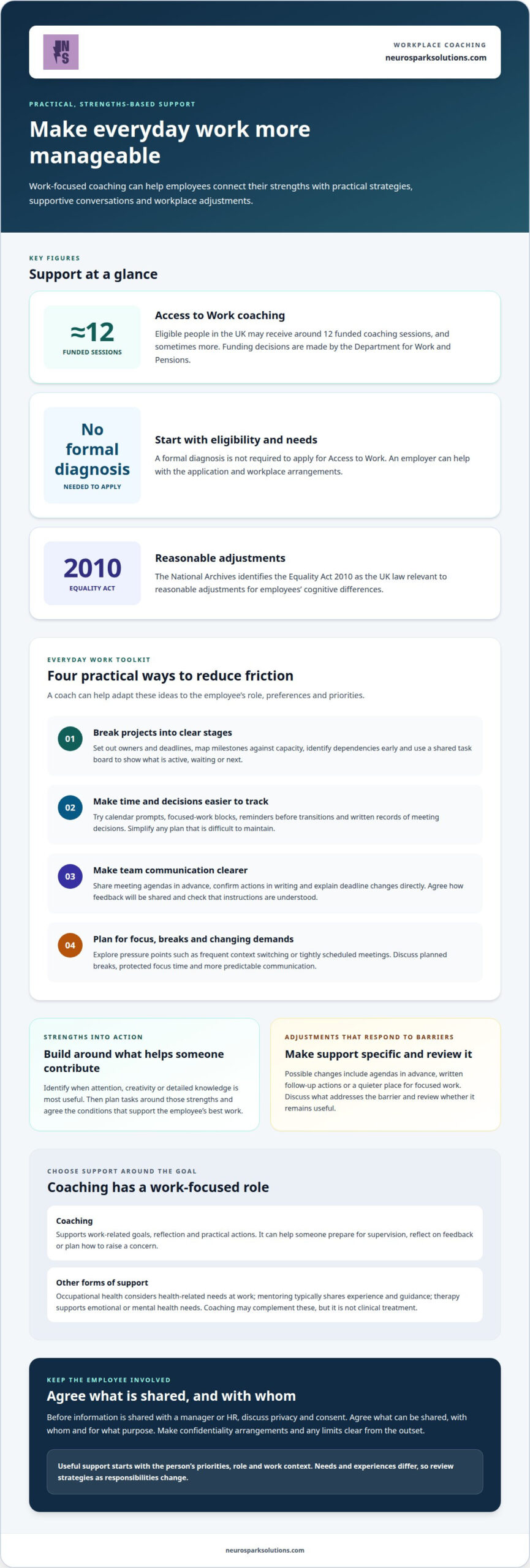
A practical starting point is to break a project brief into stages, with clear owners and deadlines. A coach might help map milestones against an employee’s capacity and identify dependencies early. A shared task board can show what is active, what is waiting and what needs to happen next. A brief weekly review with the manager can help reset priorities before competing requests cause confusion.
Calendar prompts and written records can support time management and memory. An employee might block out time for focused work, set reminders before transitions and record decisions after meetings. A coach can help adapt these habits to the person’s working preferences and review whether they are useful. If a plan is too complicated to maintain, simplifying it may make it easier to return to.
Coaching can also help employees prepare to communicate with managers and HR. With the employee’s agreement, a coach can help plan a conversation about priorities, feedback or workplace adjustments. Discuss privacy and consent before sharing information: agree what can be shared, with whom and for what purpose. Confidentiality arrangements and any limits should be clear from the outset.
Inclusive leadership makes these practices part of everyday team management. A manager could share meeting agendas in advance, confirm actions in writing and explain deadline changes directly. These steps can reduce avoidable uncertainty without singling anyone out. A coach may also help identify sources of pressure, such as tightly scheduled meetings, and support a discussion about breaks or protected focus time. HR can help coordinate agreed workplace changes while keeping the employee involved.
Neurodivergence and disability profiles supported
Coaching can support people with different neurodivergent profiles, but a label alone does not determine what will help. One person may want to build confidence in conversations, while another may seek support adapting to changing expectations or understanding feedback. Start with the employee’s priorities, role and work context, including the strengths they want to use.
Personalised actions between sessions connect coaching insights with everyday work. An employee might note which situations feel manageable, what creates overwhelm and what they would like to approach differently. The coach can use these reflections to refine goals and agree on a next step. This keeps the support responsive to the individual rather than tied to a fixed programme.
Employees early in their careers and apprentices may need time to understand workplace expectations as they learn a role. Coaching can help them prepare for a supervision meeting, reflect on feedback or plan how to raise a concern. Group coaching can offer peer perspectives and shared learning, while individual sessions provide a more private focus. The format should suit the person’s goals and comfort.
Neurodiversity coaching focuses on work-related goals. Occupational health considers health-related needs at work, while mentoring typically involves sharing experience and guidance. Therapy supports emotional or mental health needs. Coaching may complement these forms of support, but it is not clinical treatment.
Eligible people in the UK may receive around 12 funded Access to Work coaching sessions, and sometimes more. A formal diagnosis isn’t required to apply. The scheme may fund support for an eligible employee, while an employer can assist with the application and workplace arrangements. Funding decisions sit with the Department for Work and Pensions.
Strengths-based coaching and practical workplace strategies
A strengths-based approach connects an employee’s abilities with practical workplace changes. It considers both what helps someone contribute and what creates friction.
Strengths-based coaching approaches
A coach might help an employee identify when their attention, creativity or detailed knowledge is most useful. They can then plan tasks around those strengths, such as scheduling complex analysis during a focused period. Coaching should also help the employee describe the conditions that support their best work. Look for an approach that turns personal insight into agreed actions, rather than relying on general praise.
Useful adjustments respond to a specific barrier. For example, a manager might provide meeting agendas in advance, written follow-up actions or a quieter place for focused work. The National Archives identifies the Equality Act 2010 as the UK law relevant to reasonable adjustments for employees’ cognitive differences. Employers can discuss suitable adjustments with the employee and review whether they address the workplace barrier.
Responding to masking and workplace fatigue
Masking can involve hiding differences to meet perceived workplace expectations. Some employees may find particular requests or task conditions harder to approach, but experiences vary. A coach can explore situations that lead to fatigue, such as frequent context switching or unclear instructions. The employee and manager can then consider changes, such as clearer choices, planned breaks or more predictable communication.
Accessible working practices make inclusion part of everyday management. A manager could provide spoken and written instructions, agree how to share feedback and check whether adjustments remain useful. Regular reviews can help adapt support as responsibilities change. These steps can support confidence and participation without treating one working style as the standard.
Coach qualifications and lived experience
A coach’s relevant training and experience can help you assess whether their approach suits the workplace. Look for knowledge of neurodivergence, coaching skills and practical experience supporting employees. A coach should be able to discuss how autism or dyslexia may shape someone’s working preferences without assuming everyone has the same experience.
Lived experience may help a coach understand barriers such as masking or unclear expectations, but it is not a qualification by itself. Ask how the coach turns insight into practical workplace actions, such as preparing for a conversation with a manager or identifying communication preferences. A professional approach respects the employee’s account and avoids assumptions based on a label or diagnosis.
Workplace coaching experience matters because goals can involve sensitive conversations, changing responsibilities and relationships with managers. A coach should explain how goals are agreed, how progress is reviewed and how the employee stays involved. For example, they might help someone prepare for a performance discussion, then reflect on which communication approaches felt effective. Clear boundaries distinguish coaching from diagnosis or treatment.
Consider how a coach works with both the employee and the organisation. They should keep the employee’s goals central while helping managers understand practical changes, such as clearer feedback or predictable meeting formats. Neurodiversity knowledge can be supported by relevant qualifications: for example, the organisation’s training is delivered by a CEO who is TAP Accredited and holds a PG Cert in Neurodiversity. This describes training credentials, not a clinical qualification. Ask how the coach’s experience informs their coaching practice, and how they adapt their approach to different people and roles.
Neuro-Sparks training solutions
Neuro-Sparks training solutions provides neurodiversity coaching to help people navigate workplace challenges and develop their professional performance. This may suit an employee who wants to develop working strategies, manage role demands or communicate their needs more clearly. The support is personalised around the person’s priorities and work, rather than expecting them to follow a single template.
Neurodiversity workplace training can help managers and colleagues build understanding and respond constructively to different working styles. A team might focus on how it shares instructions, gives feedback or discusses adjustments. HR Teams Support can help organisations develop inclusive workplace policies and provide ongoing advice for supporting neurodivergent employees.
Neuro-Sparks offers assessments to identify appropriate workplace adjustments and support. These are not clinical diagnoses. For employees applying for Access to Work, the organisation also provides practical support and guidance through the scheme. The right starting point depends on whether the main need is individual coaching, workplace adjustments or support for the wider team.
These services can work together when that suits the situation. For instance, an employee might receive coaching while managers take part in workplace training, helping individual strategies align with team practices. Neuro-Sparks training solutions delivers workplace training virtually or in person, so you can discuss an approach suited to your organisation.
If you’d like to discuss the next step, contact Neuro-Sparks training solutions.
Frequently Asked Questions
Who is This For?
Coaching is for employees seeking practical support with work demands, communication or career development. They might be starting a new role, preparing for greater responsibility or finding that a particular task takes more effort than expected. Managers and employers can also use coaching to understand how workplace practices affect colleagues and consider changes that support participation and performance.
What is coaching for neurodivergent employees and how does it work?
Coaching for neurodivergent employees is practical, work-focused support shaped around an individual’s goals. The coach and employee agree what to work on, explore what helps or gets in the way, and identify actions to try. For example, someone preparing for a new responsibility might practise planning a handover and review how it went at a later session.
What workplace coaching approaches support ADHD, autism, dyslexia and dyspraxia?
Useful approaches respond to the person, not just a diagnostic label. Someone with ADHD may want to explore starting tasks; an autistic employee may focus on handling unexpected changes; a person with dyslexia may prefer verbal discussion alongside written materials; and someone with dyspraxia may want to plan practical task sequences. These are examples, not assumptions about everyone with those profiles.
What qualifications should a neurodiversity workplace coach have in the UK?
Look for relevant coaching training, experience supporting neurodivergent people at work and a clear explanation of the coach’s approach. Ask how they set goals, protect confidentiality and adapt sessions to different communication preferences. A coach should also explain their professional boundaries: workplace coaching supports work-related goals, while clinical diagnosis and mental health treatment are separate forms of support.
How can employees request neurodiversity coaching from their employer?
An employee can raise a request privately with a manager or HR, explaining the work situation they want help with and the coaching outcome they hope to achieve. For example, they might describe how changing priorities make it difficult to plan deadlines. They can ask about internal support or funding routes. Access to Work applications are made to the Department for Work and Pensions.
What outcomes and evidence support workplace coaching for neurodivergent employees?
Coaching aims should be practical and relevant to the employee’s role, not based on a promised result. Progress might mean completing a project plan more consistently, feeling better prepared for a review or communicating a support need clearly. Agreeing a starting point and reviewing specific examples over time can help the employee and employer judge whether the approach is useful.