


The best adjustment is the one that removes a real barrier, not the one that looks most impressive on paper. Workplace adjustments for neurodivergent employees can involve changes to communication, tasks, working arrangements or the physical environment. They should respond to the person’s needs, not assumptions about a diagnosis.
In Great Britain, employers have a duty under the Equality Act 2010 to make reasonable adjustments when a disabled worker would otherwise face a substantial disadvantage; according to the Equality and Human Rights Commission, a worker does not need a diagnosis to be considered disabled under the Act.
Finding the right support takes an open conversation and a willingness to review what works. This guide explains what reasonable adjustments can involve, how sensory needs may shape the working environment, and how a practical checklist can help identify barriers, agree changes and review them with the employee.
Key Takeaways
- Reasonable adjustments focus on removing workplace barriers, with support shaped around the individual rather than assumptions.
- Accessible written and visual information can make instructions, priorities and workplace processes easier to follow.
- Consider how light, sound and workspace design affect comfort, then agree and review practical changes with the employee.
- A clear checklist can help you identify barriers, agree a trial and record what works; workplace training and HR support can help teams put adjustments into practice.
What are reasonable adjustments?
Reasonable adjustments are changes that reduce workplace barriers when a disabled worker would otherwise face substantial disadvantage. According to the Equality and Human Rights Commission, a worker does not need a formal healthcare diagnosis to be considered disabled under the Equality Act 2010.
Accessible written and visual information
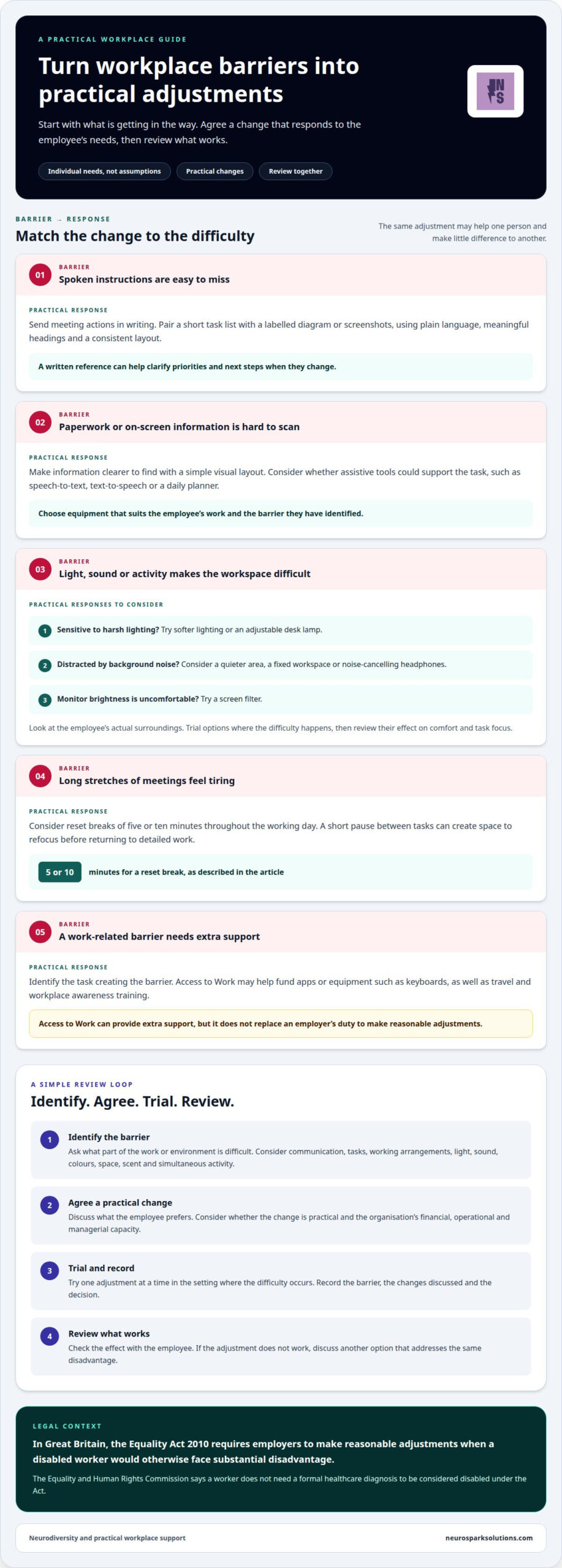
Accessible information presents instructions in a format the employee can understand and use. Pair a short written task list with a labelled diagram or screenshots. Use plain language, meaningful headings and a consistent layout. Sending meeting actions in writing gives the employee a useful reference when priorities change, instead of relying on spoken updates.
Adjustments alongside Access to Work
Access to Work is a government scheme that can help disabled employees get or stay in work. It can provide extra support, but it does not replace an employer’s duty to make reasonable adjustments. For example, an employer might agree written instructions while an employee applies for scheme support with a separate work-related barrier.
Assistive equipment and funding
Assistive equipment can support communication, reading, planning or task completion. Access to Work may help fund apps and equipment such as keyboards, as well as travel and workplace awareness training. Identify the task creating a barrier, then consider whether speech-to-text, text-to-speech or a daily planner could help. Choose equipment that suits the employee’s work.
Accessibility and workplace performance
Workplace accessibility can make everyday tasks clearer and easier to complete. If an employee misses verbal instructions in a busy meeting, a written summary can clarify priorities and next steps. If paperwork is difficult to scan, a clear visual layout can make information easier to find. These changes reduce avoidable friction and help teams focus on their work.
Equality Act duty to make reasonable adjustments
In Great Britain, the Equality Act 2010 requires employers to make reasonable adjustments when a disabled worker faces substantial disadvantage at work. The duty can apply to neurodivergent workers, including autistic people, where the legal definition of disability is met.
Individualised adjustments
Individualised adjustments respond to a worker’s barriers and job tasks, rather than providing a standard package for everyone. One autistic employee might need written agendas before meetings, while another may benefit from changing how tasks are prioritised. Discuss the specific difficulty and agree a practical response. The same adjustment may help one person but make little difference to another.
The duty covers more than permanent employees. In Great Britain, trainees, apprentices, contract workers and business partners are also covered. Adjustments can apply during recruitment, too, such as changing interview arrangements so a candidate can be considered for a role. It is useful to review each stage of work, from application and induction to day-to-day responsibilities.
Failure to make adjustments
Failing to make a reasonable adjustment when the duty applies could amount to disability discrimination. For example, if a workplace process puts a worker at a substantial disadvantage and no effective, reasonable change is made, the barrier may remain. Treat adjustment requests as work-related concerns, rather than waiting for performance to decline before exploring what could help.
Whether an adjustment is reasonable depends on the circumstances, including its practicality and the organisation’s financial, operational and managerial capacity. Record the barrier, the changes discussed and the decision, then review whether the adjustment works. If it does not, speak with the worker again and consider another option that addresses the same disadvantage.
Sensory needs in the working environment
Office lighting, background noise and strong scents can affect how comfortable a workspace feels. Sensory adjustments change the environment to reduce barriers, for example, by offering a quieter desk away from a busy corridor.
Look at the employee’s actual surroundings rather than assuming what will help. Bright ceiling lights, a shared hot-desk area or overlapping conversations may each create difficulty. Ask which conditions interrupt concentration, then discuss a change that addresses that specific issue. Sensory overload can make it harder to focus when several inputs compete for attention.
- Try softer lighting or an adjustable desk lamp where overhead lights feel harsh.
- Consider a fixed workspace, a quiet area or noise-cancelling headphones for background noise.
- Use a screen filter if monitor brightness is uncomfortable.
You can trial options in the setting where the difficulty occurs. For example, someone distracted by people passing their desk could try a quieter position for focused tasks. If a shared workspace is unavoidable, a screen filter or headphones may reduce some distractions without changing the whole room. Review the adjustment with the employee and note what helps.
Concentration can also depend on the pace and pattern of the day. A worker who finds a long stretch of meetings tiring might benefit from reset breaks of five or ten minutes throughout the working day. A short pause between tasks can create space to refocus before returning to detailed work.
Consider sensory factors together: sound, light, colours, space, scent and simultaneous activity. A letter or conversation can help identify which part of the workplace feels difficult and what change the employee prefers. Trial one adjustment at a time, then review its effect on comfort and task focus.
Neurodivergent workplace checklist
A practical checklist helps you shape workplace adjustments for neurodivergent employees around real barriers, not assumptions. In the UK, support may address communication, sensory conditions, workload, tasks or working hours.
Workplace adjustment checklist
Use a checklist to turn a workplace barrier into an agreed adjustment, trial and review. Ask the employee what is difficult and whether they want to share their neurodivergence. Get permission before changing working practices or disclosing information. Record the agreed change, who will put it in place and when you’ll review it. This keeps support clear if a manager or role changes.
- Agree one practical adjustment to trial.
- Record its effect and review date.
Adjustments for communication and sensory needs
Communication and sensory adjustments address how information arrives and what surrounds the employee. Share meeting agendas and follow-up actions in writing, allow extra processing time, or agree a daily 10-minute check-in to clarify priorities. If office noise disrupts focus, trial headphones or a quieter workspace. Ask which option suits the person’s skills and tasks, then review its effect instead of assuming.
Adjustments to workload and working hours
Adjustments to workload and hours can change the pace, sequence or timing of work. Break a large assignment into named stages, set priorities in writing or vary task types to reduce prolonged concentration demands. Flexible start times may suit an employee’s body clock, while extra breaks can help manage energy. Review whether workplace adjustments for neurodivergent employees still fit as tasks and working patterns change.
Neuro-Sparks training solutions: Workplace training
Neuro-Sparks training solutions provides workplace training to help teams turn their understanding of neurodiversity into practical support. Training can help managers recognise where workplace communication, task planning or the environment create barriers, then consider adjustments with the employee. It can also support a shared approach across the team, making agreed ways of working easier to understand and maintain.
For help navigating Access to Work, Neuro-Sparks also provides Access to Work support. This can help you understand the scheme’s role alongside workplace adjustments, which remain the employer’s responsibility. Support can be useful when considering what assistance may suit an employee’s work situation and how to put agreed support into practice.
Assessments can help inform workplace conversations when exploring neurodivergent traits or support needs. They offer a structured way to consider individual working preferences and potential barriers. An assessment is not a clinical diagnosis, and it can complement practical discussions about changes that may help at work.
HR team support can help organisations think through adjustment processes and give managers a clearer framework for responding to requests. For example, a team may need to make communication more consistent or review how adjustments are recorded when responsibilities change. The focus is practical workplace support, not a one-size-fits-all checklist.
First, consider which challenge needs attention: manager confidence, an individual’s support needs, Access to Work or an HR process. This gives you a clear starting point for deciding what support is relevant to your workplace.
Contact Neuro-Sparks training solutions to discuss workplace support.
Frequently asked questions
What reasonable adjustments are employers legally required to make under the Equality Act 2010?
Employers must consider changes that prevent a disabled person from being substantially disadvantaged at work. The duty can apply beyond permanent staff: in Great Britain, trainees, apprentices, contract workers and business partners are also covered. It can extend to recruitment arrangements, such as changing an interview format so a candidate can take part. The suitable response depends on the barrier and the work involved.
How can employees request workplace adjustments for ADHD, autism, dyslexia or other neurodivergence?
You can raise a request in a conversation or email, focusing on its practical effect at work. For example, explain that shifting priorities make it difficult to plan tasks, then suggest a regular written priority list. You can also say how you prefer to discuss the request and what information, if any, you’re comfortable sharing with colleagues.
How should employers assess and agree reasonable adjustment requests?
Give the employee space to explain the work barrier in their own words, then discuss options together. Consider whether a proposed change addresses the barrier and how it fits the role’s essential tasks. For example, a manager could trial a different way of allocating tasks before changing wider team processes. Agree how you’ll judge whether it helps, and revisit the decision if it doesn’t.
What is Access to Work, who qualifies, and what support or funding does it provide?
Access to Work is a government scheme that can help disabled people get or stay in work. Applications can be made by someone with an upcoming job interview, someone who has just started work, an existing employee or a self-employed person. Support may include travel, apps, equipment such as keyboards, and workplace awareness training. The scheme’s support is separate from the employer’s adjustment responsibilities.
Who is responsible for making workplace adjustments?
The employer is responsible for making reasonable adjustments to meet the legal duty. Access to Work may fund certain support, but it does not transfer that responsibility to the scheme. For example, an employer should still consider changing workplace communication while an employee explores scheme support for another work-related need. The right arrangement depends on the barrier and support required.
How should employers document, review and protect the privacy of workplace adjustments?
Keep a practical record of the agreed adjustment, how it will be put in place and when you’ll review it. Ask the employee before sharing personal information or changing working practices, and follow their wishes about disclosure. For example, a manager may need to know that a quiet workspace has been agreed without being told private diagnostic details. Revisit the record if work circumstances change.