



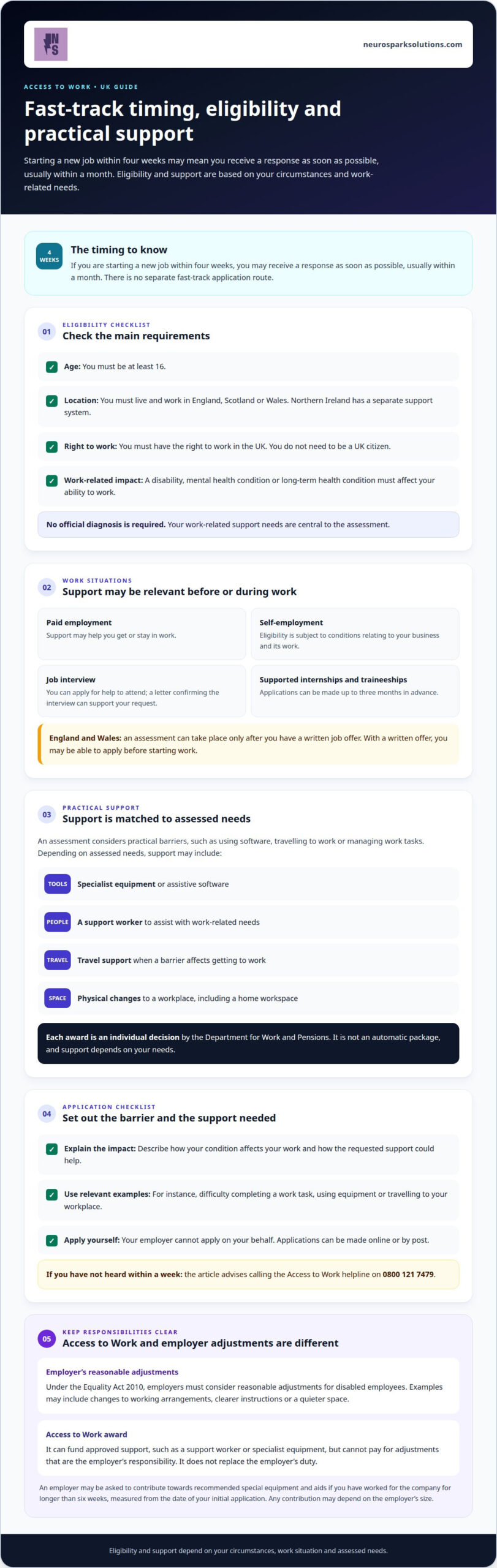
Starting a job soon can make support feel urgent. Under the access to work fast track criteria in the UK, someone starting a new job within four weeks may receive a response as soon as possible, usually within a month.
To qualify, you generally need a disability, mental health condition or long-term health condition that affects your ability to work, be at least 16, live and work in England, Scotland or Wales, and have the right to work in the UK; an official diagnosis isn’t required, and Access to Work can help with practical support, including changes to a home workspace.
That support doesn’t replace an employer’s reasonable adjustment duties under the Equality Act 2010, according to UK Parliament, so understanding the difference matters; this article explains what Access to Work covers, who may qualify and how workplace changes can make day-to-day work more workable.
Key Takeaways
- See whether your circumstances may meet the eligibility criteria, including the age and location requirements, even if you don’t have an official diagnosis.
- Understand how support can address practical barriers at work, from specialist equipment to help with travel.
- Learn how Access to Work funding differs from employers’ reasonable adjustment duties under the Equality Act 2010, according to UK Parliament.
- Explore how workplace changes, including adjustments to a home workspace, can support you while an application is in progress.
What is Access to Work?
Access to Work is a government grant that can fund practical support for eligible people to get or stay in work. The access to work fast-track criteria in the UK focus on eligibility and work needs, not a separate fast-track application route.
Fast-track criteria differ across the UK. The scheme supports eligible people who live and work in England, Scotland or Wales. Northern Ireland has a separate support system.
Eligibility Criteria
Eligibility means meeting the scheme’s age, location, right-to-work and work-related support requirements. You must be at least 16, live and work in England, Scotland or Wales, and have the right to work in the UK. You don’t need to be a UK citizen or have an official diagnosis. A disability, mental health condition or long-term health condition must affect your ability to work. These criteria help you understand whether the scheme may apply to your circumstances.
Eligible Work Situations
Eligible work situations can include paid employment, self-employment, a job interview, supported internships and traineeships. This matters if you need support before starting a role, not only after settling into a job. You can apply for help to attend a job interview, including with a letter confirming the interview. Applications for supported internships and traineeships can be made up to three months in advance.
If you’re starting a new job within four weeks, you may receive a response as soon as possible, usually within a month. In England and Wales, an assessment can take place only after you have a written job offer. If you have a written job offer, you may be able to apply before starting work. Depending on your needs, support may include specialist equipment or software.
Funding depends on your individual needs and a decision by the Department for Work and Pensions. Explain how your circumstances affect your work and how the proposed support would help. An Access to Work award is separate from an immigration decision: for an ICT visa holder, it does not itself establish eligibility for indefinite leave to remain (ILR). You must have the right to work in the UK to be eligible for Access to Work.
Access to Work support for people with a disability or health condition
Support is tailored to how a disability, mental health condition or long-term health condition affects your work. An assessment considers practical barriers, such as using software, travelling to work or managing work tasks.
Workplace Support and Adjustments
Access to Work can recommend practical support to help someone get or stay in work. Depending on assessed needs, this may include specialist equipment, assistive software, a support worker, travel support or physical changes to a workplace. For example, someone unable to use public transport to get to work may receive travel support. An award is an individual decision, not an automatic package.
An employer’s adjustments and an Access to Work award serve different purposes. An award can fund approved support, but it doesn’t replace the employer’s responsibility to consider workplace adjustments. A pending decision should not be treated as funding already available for private support.
Evidence and application support from a provider
There isn’t one set of documents for every application. Explain how your health condition affects your work and how the requested support would help. Relevant examples could include difficulty completing a work task, using equipment or travelling to your workplace. A letter confirming an interview can support a request for help attending it.
You must apply yourself; your employer cannot apply on your behalf. Applications can be made online or by post. Access to Work support from Neuro-Sparks can help you organise a clear account of your work-related needs and the practical support you’re seeking.
Professional support with refused or delayed requests
If your request is refused, Neuro-Sparks can help you review the decision and clarify how your needs affect your work. This can help you prepare questions or explain the practical support you need in further communication, without assuming a particular outcome.
If you haven’t heard about your application within a week, you’re advised to call the Access to Work helpline on 0800 121 7479. For help setting out your work-related needs, Access to Work support can help you prepare a clear account of the barriers you face and the support you’re requesting.
Employer reasonable adjustments
A faster response from Access to Work does not change an employer’s responsibilities. The scheme may support eligible workplace needs, but it does not replace adjustments an employer must consider independently.
According to UK Parliament, the Equality Act 2010 requires employers to make reasonable adjustments for disabled employees, and Access to Work funding cannot be used to pay for those adjustments.
This distinction matters in practice. A change to working arrangements, clearer instructions or a quieter space may be considered as a reasonable adjustment. Access to Work can address other approved needs, such as a support worker or specialist equipment. The right route depends on the barrier affecting the employee and the support that could address it.
An employer may be asked to contribute towards recommended special equipment and aids if the employee has worked for the company for longer than six weeks, measured from the date of the initial application. The contribution may depend on the employer’s size. This is separate from the employer’s duty to consider reasonable adjustments.
Self-employed people may also be eligible for Access to Work, subject to conditions relating to their business and its work. Their support needs are considered in the context of the work they do, rather than an employer’s workplace responsibilities.
Right-to-work checks are separate from disability support. UK employers must carry out checks before an employee starts work, regardless of nationality, and retain evidence for two years after employment ends. These checks establish permission to work, not eligibility for Access to Work.
Keeping these responsibilities distinct helps employers and workers plan appropriate support. A grant application does not remove the need to consider workplace barriers, and adjustment discussions need not depend on a grant decision.
Workplace changes, including home workspaces
Access to Work can provide practical support for a workplace, including a home workspace if you work from home some or all of the time. This may help when a disability or health condition affects how you manage tasks in that setting. A workplace assessment can explore the barriers you encounter and identify changes related directly to your work.
Start with the task that feels difficult, rather than choosing equipment first. For example, screen glare might make reading work harder, while limited space could affect how you organise materials. Access to Work grants may help pay for physical changes to a workplace. The proposed change needs to address a work-related barrier, not simply improve a room.
Working at home and in the office can present different challenges. A task might be manageable at your employer’s premises but harder to complete at home, or the other way round. Describe the setting, the task affected and how the difficulty changes your working day. That detail helps connect the proposed workplace change with your actual role.
To explain a need in your home workspace, link the barrier, the task and the practical change. For example, if the layout makes it difficult to reach work materials, describe how that affects a regular task and what change could make the setup more workable. The assessment and funding decision consider your individual circumstances and support needs.
Clear information about your working environment can help make the issue easier to discuss. If you want support considering workplace needs and practical options, get Access to Work support.
Neuro-Sparks training solutions: Workplace training
Neuro-Sparks training solutions can help you connect Access to Work support with practical workplace changes. If you’re unsure how to describe the barriers affecting your work, its support can help clarify the needs you want to address.
Workplace training can help managers and teams understand how different working styles affect communication, tasks and day-to-day collaboration. HR team support can help organisations consider how practical changes fit their workplace processes. Assessments can also identify needs that may inform support planning.
This support can be useful when you need to understand your options, prepare for workplace conversations or build shared understanding across a team. It complements, rather than replaces, an Access to Work decision or an employer’s responsibilities.
To talk through your workplace needs, contact Neuro-Sparks training solutions.
Plan your next workplace conversation
Understanding the Access to Work fast-track criteria in the UK gives you a starting point. Next, describe what would make work more workable for you. Consider the barriers you want to address and how a practical change could help you take part in your role with greater confidence.
Neuro-Sparks training solutions offers workplace training, assessments and HR team support to help people and organisations build understanding and plan practical workplace support. Its team can help you consider how individual needs connect with day-to-day working practices.
You don’t have to have every detail worked out before starting a conversation. Contact Neuro-Sparks training solutions to talk through the support that may fit your workplace needs. A clearer next step can help you move forward with confidence.
Frequently Asked Questions
What happens after you apply?
The Department for Work and Pensions reviews your application and decides whether to award support. If you receive an award, read the letter carefully: it sets out the approved support, dates and claim requirements. You have nine months to claim awarded funding. Funding agreements can cover up to three years, with reviews normally taking place annually, so keep the award details available.
Who is eligible?
Eligibility depends on your circumstances and work situation. For self-employed applicants, the 2026/27 tax-year threshold is earnings above £559 per month or £6,708 per year, alongside conditions relating to the business and its work. Civil Service workers cannot receive Access to Work. These details can help you identify whether a less common work situation affects your application.
Does it affect my benefits?
No, an Access to Work grant does not affect your other benefits and does not have to be repaid. However, receiving certain benefits can make you ineligible for the scheme. These include Incapacity Benefit, Employment and Support Allowance, Severe Disablement Allowance, Income Support and National Insurance credits. The grant’s effect on benefits and the eligibility rules are separate considerations.
How long does it take for a grant to be approved?
The time to approval can vary. Access to Work says it will contact applicants within 12 weeks, but that does not mean a grant will be approved within that period. Reported waiting times are around 20 weeks. Contact from the scheme and a final funding decision are different stages, so allow for the assessment and decision process.
What support can be funded?
Support can include work-focused mental health assistance. Access to Work’s Mental Health Support Service may provide a tailored plan and one-to-one sessions with a mental health professional for up to nine months. This is intended to help someone get or stay in work. The support addresses work-related needs, rather than providing a clinical diagnosis or general mental health treatment.
What are the waiting times?
Assessment waits can be longer than the time taken to receive initial contact. People already working may wait weeks for an assessment, and some applicants were waiting several months as of 2025. These are different stages of the process, and waiting times can change. Knowing which stage is pending can help you understand what progress has or hasn’t happened.