



Access to Work support can help remove practical barriers to getting or staying in work, including through support from a job coach or communicator when those roles fit your needs. In England, Scotland and Wales, applicants must be aged 16 or over; according to the Department for Work and Pensions, the scheme can support people with a disability or health condition who are in work, starting a job or attending an interview for paid work, and you don’t need an official diagnosis to apply. The practical question is how to explain the barriers you face and identify help that addresses them; this guide explains what Access to Work can fund, how to prepare for conversations and a workplace assessment, and the difference between grant-funded support and adjustments your employer is responsible for making, before outlining roles such as support workers, job coaches and communication support.
Key Takeaways
- Understand how grant-funded help fits alongside your employer’s responsibility to make reasonable adjustments.
- See the key eligibility criteria in England, Scotland and Wales, including how applying works without an official diagnosis.
- Prepare to describe how workplace barriers affect your tasks, and what information may help during a conversation or assessment.
- Explore support roles that may address practical work needs, from job coaching to communication assistance.
What is Access to Work?
Access to Work is a UK grant scheme that may help people with a physical or mental health condition or disability get or stay in work. It can fund practical support linked to workplace barriers, rather than replacing the support an employer must provide.
Application, renewal and claims support
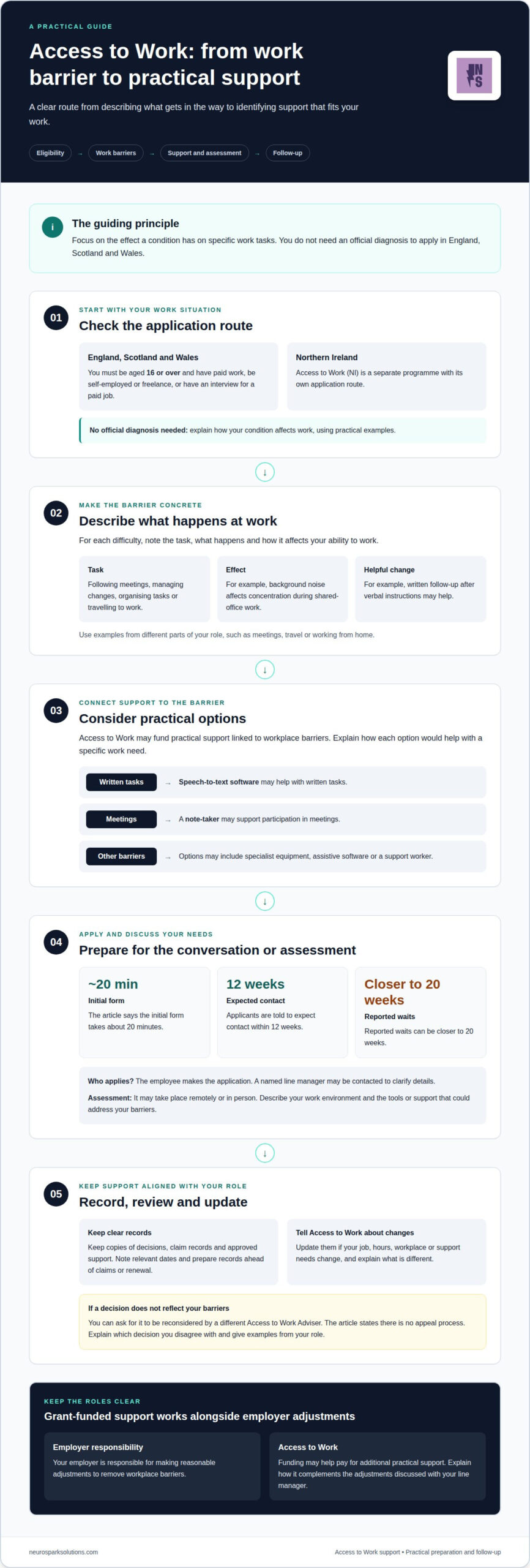
Before applying, note how your condition affects specific tasks, such as following meetings, managing changes or travelling to work. Organise examples, possible support and questions about claims or renewing an award in one place. Keep copies of decisions and claim records so you can refer to the support agreed.
If your job, hours, workplace or support needs change after an award, update Access to Work and explain what has changed. This helps show whether the approved support still addresses your barriers. Don’t assume a renewal or claim will be handled automatically. Note relevant dates and gather records in advance.
Eligibility and application process
In England, Scotland and Wales, you must be aged 16 or over to qualify, according to the Department for Work and Pensions. You must also have a paid job, be self-employed or freelance, or have an interview for a new paid job. You can apply without an official diagnosis if you can describe how your condition affects work.
The employee makes the application, although a named line manager may be contacted to clarify details. The initial form takes about 20 minutes. Applicants are told to expect contact within 12 weeks, while reported waits can be closer to 20 weeks. Northern Ireland uses a separate support system.
If a decision doesn’t reflect your work barriers, you can ask for it to be reconsidered by a different Access to Work Adviser. There is no appeal process. Identify the decision you disagree with and explain, using examples from your role, why the recommended support doesn’t meet your needs.
Access to Work and employer adjustments
Reasonable adjustments are changes an employer makes to remove workplace barriers. Access to Work funding can help pay for additional practical support, but it doesn’t replace that employer responsibility. According to UK legislation.gov.uk, Access to Work does not replace an employer’s duty under the Equality Act 2010 to make reasonable adjustments.
For example, an adjustment might change how instructions are given, while grant-funded support could address a separate work-related need. Discuss adjustments with your line manager and explain what you’re asking Access to Work to fund, so each form of support has a clear, complementary purpose. For further guidance on HR support for neurodiversity through adjustments and inclusion, consider how HR and managers can make support practical and responsive to individual needs.
Eligibility for disabled employees
Eligibility depends on where you live and your connection to paid work. Access to Work considers how a physical or mental health condition affects your ability to work.
Eligibility criteria and who can apply
According to the Department for Work and Pensions, a person must be aged 16 or over to qualify for Access to Work support in England, Scotland and Wales. Eligibility generally depends on having a work-related situation, such as paid work or an interview.
You don’t need an official diagnosis to apply. Explain how your condition affects your work, with practical examples such as difficulty managing written instructions or organising tasks. The scheme focuses on barriers in a particular job, not diagnosis alone.
Paid apprenticeships and internships may qualify. If you’re an employee, you make the application, and your employer may be asked to clarify details. A support worker or specialist may be relevant if you need practical help with your role, but eligibility depends on your circumstances and work barriers.
Eligibility across the UK
Are the rules different across England, Scotland, Wales and Northern Ireland? England, Scotland and Wales use Access to Work, with the same minimum age requirement. Northern Ireland has a separate programme, Access to Work (NI), rather than the Great Britain scheme.
In Northern Ireland, support is tailored to your needs in a particular job or while travelling to and from work. It may cover extra approved costs arising from disability, including support workers, special aids or travel within work. The programme has a separate application route.
Wherever you live, start by identifying the work situation and explaining how your health condition affects it. For instance, describe whether a barrier arises during a regular task, at an interview or on the journey to work. Clear examples help distinguish a practical workplace need from a general request for help.
Preparing for case manager conversations and workplace assessments
A clear account of your work barriers helps a case manager understand what practical support could make a difference. Focus on specific tasks, settings and effects on your ability to work.
Before a conversation, note the task that causes difficulty, what happens and what might help. For example, explain how background noise affects concentration during shared-office tasks, or how written follow-up helps after verbal instructions. Include examples from different parts of your role, such as meetings, travel or working from home.
Consider support options in practical terms. Access to Work may fund specialist equipment, assistive software, a support worker or other workplace-related help. Explain how each option would address a barrier. For instance, speech-to-text software may help with written tasks, while a note-taker may support participation in meetings.
Do grants need to be repaid? Access to Work grants don’t have to be repaid and don’t affect other benefits. Keep records of approved support and payments so your claims match the award.
Can support cover home working or a mental health condition? Your home can count as your workplace if you work there some or all of the time. Support may include home adjustments if your health condition means you sometimes need to work remotely. Mental health support can include a tailored, work-focused plan.
An assessment may take place remotely or in person. Describe your work environment, the tools already available and any adjustments in place. If you’re eligible, link each requested item to a specific barrier, such as software for managing written information or equipment that makes your workstation easier to use. A neurodiversity workplace assessment can also help identify how role demands, working conditions and communication practices contribute to barriers and inform practical changes.
Access to Work-funded support roles
A support role can address barriers that equipment or workplace adjustments don’t resolve. The right match depends on the affected tasks, the setting and the help approved through Access to Work. Describe the outcome you need, such as following spoken instructions, travelling independently or building confidence in a new role.
A job coach can help you learn duties, practise routines and build confidence at work. A workplace strategy coach may help identify practical approaches to tasks, while a job aide can support a specific activity. These roles differ, so explain whether you need ongoing help developing skills or focused assistance with a particular work task.
Communication support can help you take part in interviews or workplace activities. Depending on your needs, it may include a British Sign Language interpreter, lipspeaker, communicator or note-taker. For example, a note-taker may help capture key points in a meeting, while an interpreter supports communication between people using different languages or communication methods.
Travel support may include a travel buddy to help with journeys connected to work. Explain which part of the journey creates a barrier and what would make the route manageable. For a mental health condition, support may instead focus on a tailored plan to help you get or stay in work.
There isn’t an official list of Access to Work support workers or coaches. Focus on the role’s purpose and how it relates to your work needs. An adviser considers your circumstances and the practical support required, so a role title alone won’t explain why you need the help. Link each requested role to a work task, such as learning a process, taking part in meetings or travelling to work. Reasonable adjustments remain a separate part of workplace support.
If you’re unsure how to describe a support role’s purpose, talk through suitable workplace support.
Neuro-Sparks training solutions: Workplace training
Neuro-Sparks training solutions offers workplace training, Access to Work support and HR team support to help turn workplace barriers into practical steps. These services can help when you need to understand an assessment outcome, plan adjustments alongside funded support or give managers clearer ways to support a colleague.
For example, training can help a team make instructions clearer and agree working practices that support participation. HR team support helps employers consider how individual needs relate to everyday workplace processes. Assessments can also build understanding of support needs, without replacing the Access to Work decision-making process.
To discuss your workplace needs, contact Neuro-Sparks training solutions.
Make your next step practical
Choose one change that would make your working day more manageable, then decide what progress would look like. A useful plan links that goal to actions, responsibilities and a review of how things are working. This keeps Access to Work support connected to real workplace needs as your role or circumstances evolve.
You could also consider what would help your wider team work well with you. Clear communication and shared expectations can turn an agreed approach into everyday practice. Neuro-Sparks training solutions’ training is delivered by a CEO who is TAP Accredited and holds a PG Cert in Neurodiversity, bringing practical knowledge to workplace inclusion.
If you’d like to explore a next step for your workplace, contact Neuro-Sparks training solutions. A thoughtful plan can help you move forward with greater clarity.
Frequently Asked Questions
How to apply?
You can apply by phone on 0800 121 7479, Monday to Friday, 9am to 5pm. Have your National Insurance details and contact information ready, and set aside time to complete the application carefully. If calling is difficult, the scheme also has an online application route. Keep a note of when you applied and any reference details you receive.
Who can get help?
The scheme is for people whose disability or health condition creates a barrier to getting or staying in work. Support can address practical work needs, including getting to a workplace or communicating during work-related activities. It may also apply to work experience or a work trial. For supported internships and traineeships, you can apply up to three months in advance.
How do I apply for Access to Work and what information do I need?
Use the application route to explain the support you’re seeking and the work situation it relates to. Be ready to describe your job or work activity, when you need help and how it would be used. If you’re applying for a supported internship or traineeship, include its planned start and placement details so your request relates to the right opportunity.
What support can Access to Work pay for, such as equipment, travel, and support workers?
Possible support includes specialist equipment, assistive software, help from a support worker and travel assistance where public transport isn’t usable. The scheme may also contribute towards physical changes to a workplace or participation in a work experience placement or trial. Explain how the requested help relates to your work situation and the barrier it is intended to address.
Can employees, self-employed people, apprentices, and job applicants apply for Access to Work?
Employees, self-employed people and applicants for paid jobs can apply. Paid apprenticeships and internships may also qualify. Support can be relevant beyond an established job, including for a work trial or work experience. If you’re arranging a supported internship or traineeship, you can apply up to three months before it begins.