



A rejected Access to Work decision is not necessarily the end of the process. A clear explanation and relevant evidence can help show how the support you requested relates to your work needs. This guide explains how to appeal an Access to Work rejected decision, what to check about deadlines and permissions, and how to organise your forms and supporting documents. Start with the instructions in your decision letter, because the right route depends on the decision you received.
Key Takeaways
- Start with the decision letter to identify the appeal route and any deadline that applies to your case.
- Set out why you think the decision should change, linking each point to relevant evidence.
- Organise your forms and supporting documents so the reasons for your appeal are clear.
- Understand when permission may be needed and what to do if the usual deadline has passed.
Appeal deadlines and late appeals
Read your decision letter first. Access to Work decisions and benefit appeals can follow different routes, and the letter should explain how to challenge the decision and where to send your request.
Reapplying and challenging a decision are different options. A rejection alone does not tell you whether you can reapply, so follow the route and reasons in your letter. To challenge the decision, respond to the specific reasons given. A benefits adviser, union or disability charity may also help you understand the process and organise your explanation.
Calculate the appeal deadline
- Note the date on your decision letter and the date you receive any mandatory reconsideration decision. According to the Department for Work and Pensions, a mandatory reconsideration request for a benefit decision is normally due within one month of the date on the decision letter. A benefit appeal to the tribunal normally must be made within one month of receiving the mandatory reconsideration decision.
Those time limits apply to benefit decisions, so do not assume they automatically apply to an Access to Work decision. Follow the route and deadline stated in your letter.
Lodge the notice on time
- Use the procedure named in your decision letter and submit the required application within its deadline. An Appellant’s Notice is used for a court appeal, not as a general form for challenging an Access to Work rejection. In most Court of Appeal cases, the notice must be lodged within 21 days of the decision being appealed.
Keep a copy of your writing and submission record. For a benefit appeal, the DWP normally has 28 days to respond after HMCTS or the Appeals Service sends it a copy; it can request an extension. An oral hearing requires 14 days’ notice.
If a benefit reconsideration request is late, it may be accepted up to 12 months after the usual deadline where special circumstances made a timely request impracticable and the decision maker considers the delay reasonable. A tribunal can extend a late benefit appeal by up to 12 months, making 13 months in total. Explain the delay clearly; a late appeal may not be accepted.
Permission to appeal
First identify which decision you want to challenge. Permission rules for courts and tribunals relate to later appeals, not the initial challenge to an Access to Work decision.
- Separate an Access to Work challenge from an appeal on a legal point. A tribunal decision may be appealed to the Upper Tribunal if you believe it was wrong for a legal reason. Explain the legal error you say occurred, rather than simply saying you disagree with the outcome. For an Access to Work rejection, follow the challenge route in your decision letter; don’t assume tribunal permission rules apply to it.
- Check the route if judicial review permission is refused. In England and Wales, if the High Court refuses permission for judicial review, an Appellant’s Notice must be lodged within 7 days. This short deadline applies to that court route, not every Access to Work challenge. Identify the court decision date and the appeal route before preparing an application, so you don’t use the wrong procedure.
- Apply the relevant rules in family proceedings. Under rule 30.3(7) of the Family Procedure Rules 2010, permission may be granted where an appeal has a real prospect of success or another compelling reason to be heard. Paragraph 4.18 of Practice Direction 30A addresses permission granted on some issues. Paragraph 4.21 of Practice Direction 30 says permission cannot be renewed at the appeal hearing if an appeal court refused it at or after an oral hearing.
- Act promptly after a refusal by the Employment Appeal Tribunal. If an Employment Appeal Tribunal judge refuses permission on the papers, you have 14 days to apply for a rule 3(10) permission hearing. For Court of Appeal cases, permission is required in most cases, and the appeal must show a realistic prospect of success. Further appeal options may be limited after permission is refused, so check the applicable procedure before deciding what to do next.
Preparing written explanations and evidence
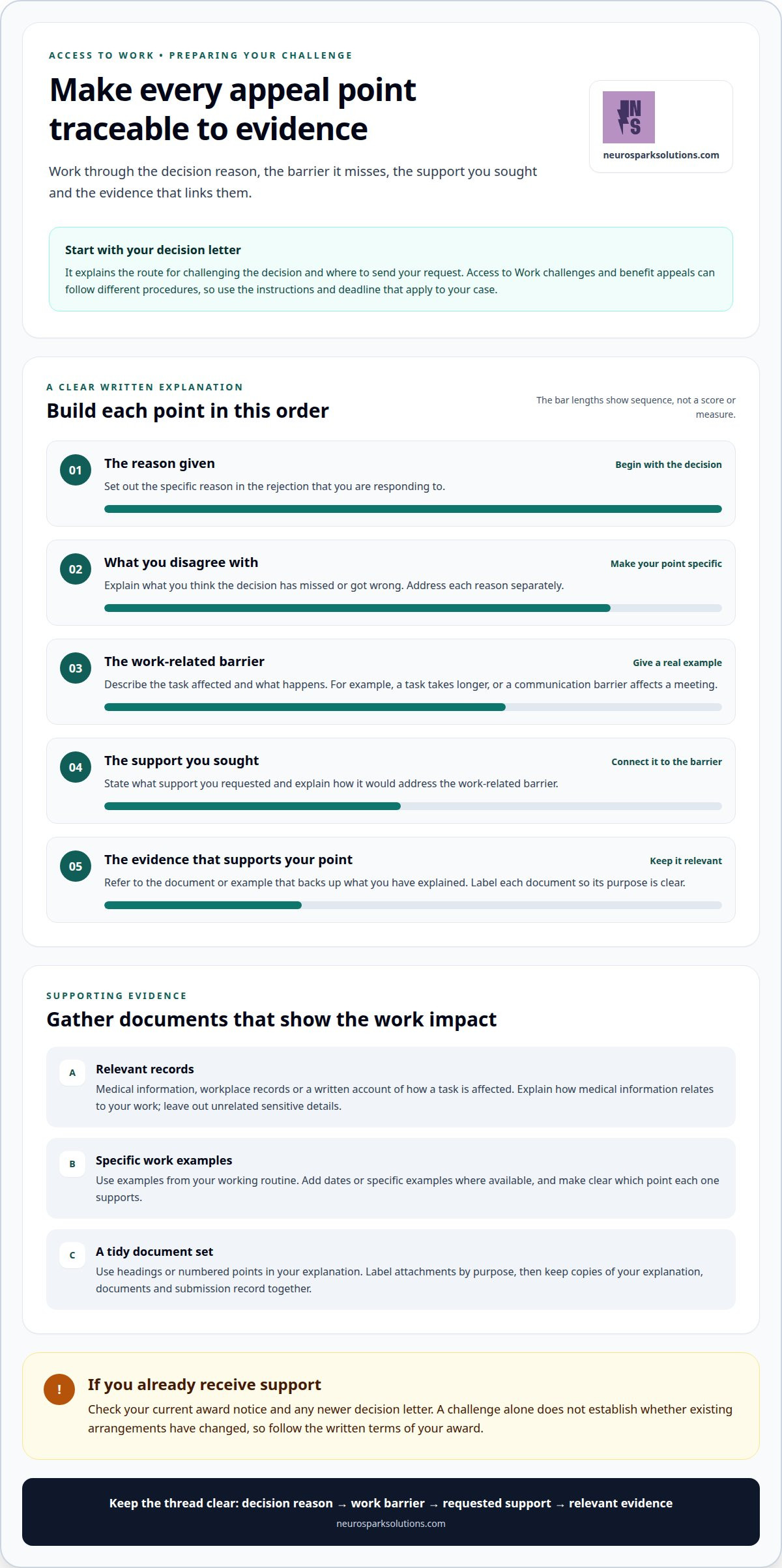
Gather documents that connect the reasons for the decision to your work needs. Explain clearly what you disagree with and why.
To challenge a rejected Access to Work application in the UK, follow the review or challenge instructions in your decision letter. Explain which points you dispute and include evidence that relates directly to them.
If you already receive Access to Work support, check your current award notice and any newer decision letter. A challenge alone does not establish whether your existing arrangements have changed, so follow the written terms of your award.
Gather supporting evidence
- Collect evidence that illustrates the work-related barrier and the support requested. This could include relevant medical information, workplace records, or a written account of how a task is affected. Medical evidence can add context, but explain how it connects to your work rather than sending unrelated records.
Include examples from your working routine, such as a task that takes longer or a communication barrier affecting a meeting. Add dates or specific examples where available, and label each document to show its purpose. Leave out sensitive personal information that does not support a point in your challenge.
Prepare a written explanation
- Address each reason in the rejection separately. State what the decision says, where you disagree, what support you sought, and which evidence supports your view. Keep the explanation focused on the decision, not on every difficulty you experience at work.
For example, if the decision overlooks a particular work task, describe the task, the barrier you encounter and how the requested support would address it. Use headings or numbered points to make each connection easy to follow, then check that you have attached the relevant documents.
After submitting a tribunal appeal, you can manage it online and provide evidence to the tribunal. This applies to tribunal appeals, so do not assume the same online process is used to challenge an Access to Work decision. Keep copies of your explanation, attachments and submission records together in case the matter proceeds to an appeal hearing.
Appeal forms and supporting documents
Use the form and submission route that apply to the decision you are challenging. Access to Work requests and DWP benefit appeals follow different processes.
For an Access to Work complaint or decision review, follow the submission instructions in your decision letter. Do not send it to a tribunal using a benefit appeal form unless you are challenging a separate benefit decision.
- Choose the correct form. In Great Britain, a DWP benefit appeal can be made online or using form SSCS1. The form and process for a benefit appeal may vary depending on where you are. These are benefit appeal routes, not general Access to Work review forms. For your Access to Work decision, use the route stated in its letter.
- Complete every relevant part of the application. Give your details, identify the decision you’re challenging and explain what outcome you’re seeking. Use the decision letter to copy the relevant reference or date accurately. If a question doesn’t apply, make that clear rather than leaving the tribunal or decision maker to guess.
- Arrange your documents around your argument. Include the decision letter, your written explanation and evidence that supports each point. Label attachments clearly, such as “work task example” or “supporting report”, and refer to those labels in your explanation. This helps the parties understand how each document relates to the decision.
- Submit the application and keep a record. Check that required sections are complete and attachments open correctly before sending. Keep a copy of the form, documents and submission confirmation. The Social Security and Child Support Tribunal is independent of government and considers both sides before deciding. A complaint or review of an Access to Work decision is a separate matter, so use the address or submission method in that decision letter.
Clear, well-organised forms and documents make your case easier to follow, whether a decision maker reviews your request or a tribunal hears a benefit appeal.
Send your request using the address or submission method stated in your decision letter.
Neuro-Sparks training solutions: Workplace training
Neuro-Sparks training solutions provides Access to Work support to help you understand how workplace support relates to your needs. After reviewing a decision, you may want to clarify the practical barriers you face at work and the support that could address them. Workplace training can also help teams understand neurodiversity and the adjustments that support participation and performance.
Turn to this support when you are ready to consider your workplace needs alongside your decision challenge. It can complement your appeal preparation, but it does not replace the formal route or deadline in your decision letter.
To discuss your workplace support needs, contact Neuro-Sparks training solutions.
Plan your next workplace step
Understanding how to appeal an Access to Work rejected decision can help you explain your case clearly. You can also consider what would make your working routine more manageable and which practical changes could support your participation.
Neuro-Sparks training solutions’ work is informed by its CEO’s TAP accreditation and PG Cert in Neurodiversity. If you’d like to talk through your workplace needs and possible next steps, contact Neuro-Sparks training solutions.
Start with the change that would make the clearest difference to your working day. Choosing a practical next step can help you move forward with confidence.
Frequently Asked Questions
What is an appeal?
An appeal asks a separate decision-making body to examine a decision through a formal process, where that route is available. This differs from asking the original decision maker to review its own decision. If you are considering how to appeal an Access to Work rejected decision, first establish whether your letter describes an appeal, a complaint or another review process. The process name matters because each route handles the issue differently.
The Critical First Choice: Appeal or Reconsideration?
A reconsideration asks the original decision maker to look at its decision again. An appeal goes to a separate body when the rules allow it. Before choosing a route, identify the decision you want changed and the process named for it. If you are challenging more than one decision, keep each request separate and state which outcome you want the relevant decision maker or tribunal to consider.
What is the deadline to ask for an Access to Work decision review or appeal?
Follow the time limit given for the specific route in your decision correspondence. If the letter gives a date, record it and plan to send your request before then. Keep a copy of what you submit and evidence of when you sent it. If the instructions are unclear, contact the decision-making team promptly to clarify the process and deadline.
How do I request a mandatory reconsideration of an Access to Work decision?
Mandatory reconsideration is not the general term for challenging an Access to Work decision. Check your correspondence for the process that applies, then send your request to the named team or destination. If you are also dealing with a separate DWP benefit decision, keep its reconsideration request distinct so each matter is considered under its own process.
What evidence should I submit when challenging an Access to Work rejection?
Choose documents that directly support the points you are asking the decision maker to reconsider. Make a simple index listing each document and the point it relates to, and remove duplicates. If a document includes unrelated information, direct attention to the relevant section. This makes your evidence easier to navigate without adding personal details that do not support your challenge.
Can I appeal an Access to Work decision to a tribunal?
A tribunal appeal is available for decisions within its jurisdiction; it is not a route for every public decision. Before preparing tribunal papers, check whether your decision letter identifies a right of appeal to a tribunal. If it does not, use the challenge procedure given for that decision. Keep any separate tribunal case and Access to Work correspondence clearly labelled to avoid mixing up the paperwork.