



Neurodiversity describes the natural variation in how people think, process information and experience the world. Neurodivergence includes differences such as ADHD, autism and dyslexia. Effective neurodiversity policies for the workplace turn this understanding into clear, consistent ways to remove barriers and help employees participate and do their best work.
In the UK, the Equality Act 2010 protects disabled employees from discrimination because of disability and gives them the right to reasonable adjustments, according to The National Archives. A policy can help make recruitment, workplace communication and agreed adjustments clearer, while recognising that people have different needs and preferences.
You’ll learn how accessible recruitment, employee participation, shared responsibility and visible leadership advocacy can move inclusion beyond awareness. This article also explores how practical training and support help managers put policy into practice, without making assumptions about individual employees.
Key Takeaways
- Make recruitment more accessible by inviting applicants to share adjustment needs and adapting interviews where appropriate.
- Ask employees about their working preferences instead of making assumptions, and give them safe ways to shape workplace practices.
- Equip managers and HR teams to turn inclusion principles into everyday support and fairer ways of working.
- Show leadership commitment through visible advocacy and regular attention to how workplace policies affect people.
Accessible recruitment and interviews
Neurodiversity policies for the workplace can set a consistent approach to accessible recruitment, interviews and workplace participation. According to The National Archives (legislation.gov.uk), in the United Kingdom, the Equality Act 2010 protects disabled employees from discrimination because of disability and gives them the right to reasonable adjustments. A written process helps managers respond consistently.
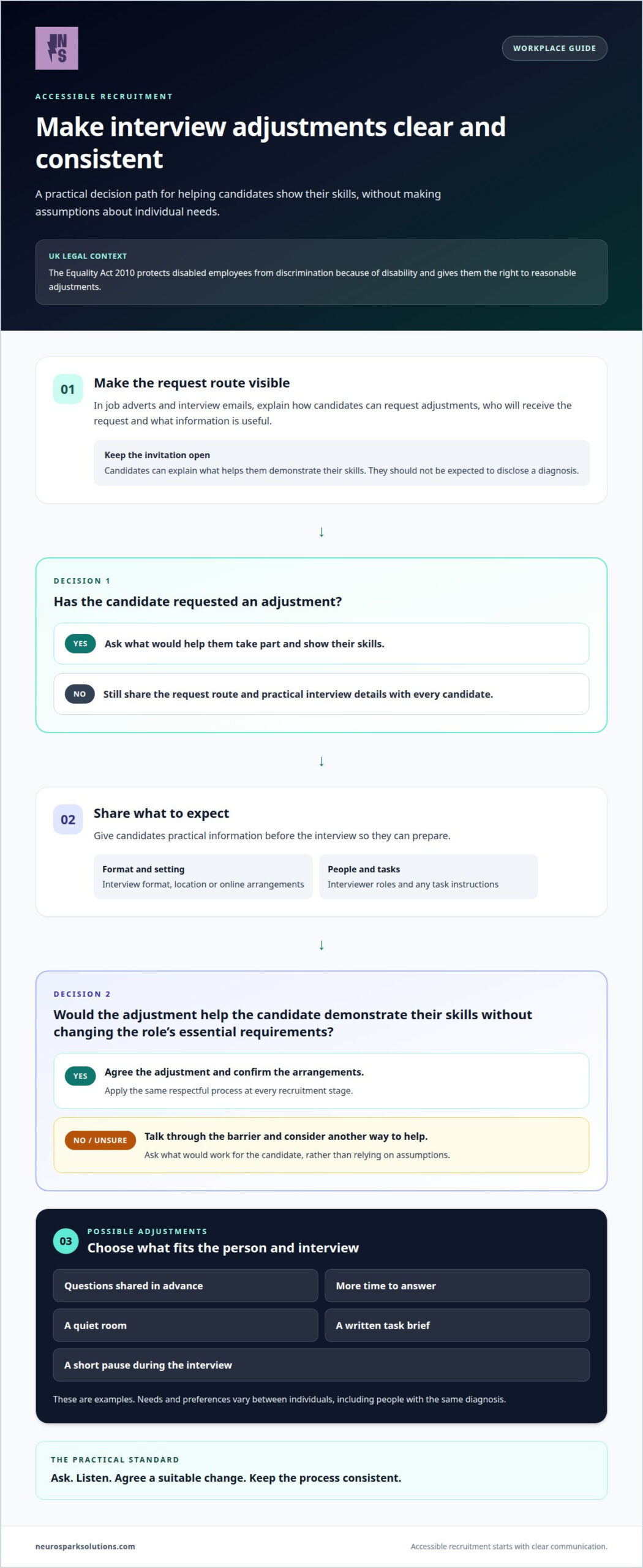
Tell applicants how to request adjustments, who will receive the request and what information is useful. Include this invitation in job adverts and interview emails. Candidates should be able to explain what helps them demonstrate their skills without being expected to disclose a diagnosis. Apply the same respectful process at every recruitment stage.
Before interviews, share practical details: the format, location or online arrangements, interviewer roles and any task instructions. Where appropriate, provide questions in advance and allow applicants more time to answer. A quiet room, written task brief or short pause can reduce avoidable pressure without changing the role’s essential requirements.
What reasonable adjustments should UK employers make for neurodivergent staff? Ask each person what would help, then agree changes that suit their role and preferences. Examples include flexible start and finish times, movement breaks, assistive technology, extra time to read notes or a quieter space. Record decisions and revisit them when duties change.
What workplace adjustments help employees with ADHD, autism, dyslexia and dyspraxia? Options may include written instructions, meeting agendas shared beforehand, adjustable lighting or noise-reducing equipment. Needs vary between individuals, even among people with the same diagnosis. Discuss the specific barrier and consider whether the proposed change helps.
Accessible services and programmes should offer different ways to take part, such as written materials alongside spoken information or a choice to contribute verbally or in writing. Neurodiversity policies for the workplace can clarify who coordinates this support. The Department for Work and Pensions says disabled employees might be able to get support through Access to Work to help them get or stay in work.
Employee participation and neurodivergent voices
Effective workplace policies give employees clear ways to share feedback and influence working practices. Offer private conversations, anonymous feedback and staff network discussions. Explain who will see responses and how they may inform decisions. These options let people contribute in ways that suit them, without requiring public disclosure or making one format the only way to be heard.
Ask each employee what helps them do their work. Someone might prefer written priorities, clear meeting outcomes or notice before a process changes. Don’t infer needs from an ADHD, autism, dyslexia or dyspraxia diagnosis. People with the same diagnosis may have different preferences. Agree support around the individual’s role, then revisit it when responsibilities or working conditions change.
Masking can involve hiding or suppressing behaviours to meet workplace expectations. Rigid communication norms or negative reactions to difference may add pressure. Managers can make it safer to speak up by responding respectfully, challenging exclusionary behaviour and offering a confidential way to raise concerns. Employees shouldn’t have to disclose a diagnosis before their feedback about workplace barriers is taken seriously.
What are the risks of failing to support neurodivergent employees in the UK? Unaddressed barriers can affect wellbeing and participation. Behaviour related to neurodivergence may amount to disability discrimination or harassment. Bullying can also create legal issues, even when it isn’t classed as discrimination.
Listening can help organisations make better use of people’s strengths. Neurodivergent employees may bring different skills and approaches to creative thinking and problem-solving. Their perspectives can inform services that work for a wider range of people. The practical benefit comes from designing roles and team processes so people can contribute, rather than expecting them to spend energy concealing how they work best.
Use employee feedback to identify a specific change, such as clearer team communication or fairer access to development. Effective neurodiversity policies for the workplace should show how staff input leads to action. If your organisation needs support with this work, explore support for neuroinclusive workplaces.
How workplace roles contribute to neuroinclusion
A useful policy gives managers and HR teams clear responsibilities, not just general principles. Explain how employees can raise support needs, how requests are handled, who agrees workplace changes and how confidentiality is protected. Include a route for reporting bullying or harassment and a process for reviewing decisions. For example, a manager can discuss a request privately, agree next steps with HR and record the outcome securely.
What should a workplace neurodiversity policy include? Set out practical expectations for recruitment, communication, adjustments, complaints and career development. Name the roles responsible for each process, so employees know where to turn and managers can respond consistently.
HR professionals can shape fair processes, while line managers put them into practice through everyday conversations and work planning. Training should help both groups respond to individual needs without relying on assumptions about autism, dyslexia or other forms of neurodivergence. A manager might ask how an employee prefers to receive feedback, then agree clear written priorities. HR can help with complex requests and identify patterns across teams.
Awareness sessions are a starting point, not the whole answer. Training can use workplace examples to explore communication differences, accessible instruction and how unclear expectations affect participation. Among employers surveyed, 56% agreed or strongly agreed that HR staff felt capable and confident supporting neurodivergent people. In a separate finding, 73% said their organisation encouraged managers to learn what team members enjoy and find challenging. These results point to the value of practical skills, not awareness alone.
What should you measure? Review how policies work in practice by gathering confidential employee feedback, checking whether requests receive clear responses, and discussing barriers with managers and HR. Among employees surveyed, 46% said their manager allocated work around individual strengths and interests. Yet only 19% of employers said their organisation had reviewed formal people-management policies for neuroinclusion. Use these measures to identify a specific improvement, assign responsibility and revisit progress at the next policy review.
Neurodiversity awareness and leadership advocacy
Awareness matters, but leadership advocacy makes inclusion visible in everyday decisions. ACAS estimates that around one in seven people in the United Kingdom are neurodivergent. Leaders can set a clear expectation: colleagues should be treated fairly, and practical adjustments are part of good work design.
Make advocacy tangible. Senior leaders can speak about neurodiversity at team meetings, explain why inclusive practices matter and share their lived experience if they feel comfortable. They can also review how policies shape routine decisions, including how meetings are run, feedback is given and development opportunities are offered. A statement without follow-through risks feeling disconnected from employees’ daily experience.
Survey findings highlight the gap between intention and action. Among organisations surveyed, 60% said neuroinclusion was a focus. Yet, among senior managers with decision-making influence surveyed, 56% said their leaders appreciated neurodiversity’s value, while 53% said leaders demonstrated commitment through their actions and behaviour. These figures point to a practical test: do employees see leaders making inclusive choices?
Language shapes that experience. Use respectful wording in internal communications, avoid treating neurodivergence as a problem to fix, and ask people how they prefer to be described. For example, a leadership message could welcome different thinking styles and invite staff to suggest changes that would make learning, meetings or feedback more accessible.
Leaders also need to make room for ongoing learning. Set time to review employee feedback, discuss barriers with managers and track whether agreed adjustments remain useful. Share what has changed as a result while protecting individual privacy. This closes the loop between employee input and organisational action.
For senior teams ready to turn advocacy into consistent practice, explore senior leadership training focused on neuroinclusion.
Neuro-Sparks training solutions: Workplace training
Neuro-Sparks training solutions can help your organisation put neuroinclusion into practice through workplace training and HR team support. This support is useful when managers need practical guidance or a written policy needs to inform everyday team decisions.
Training can help staff understand different working preferences and respond thoughtfully to support requests. HR team support can help clarify processes for workplace adjustments and employee participation. For individual workplace needs, Access to Work support and assessments are also available.
These services can complement your organisation’s policy by helping managers and teams apply its principles consistently. To discuss workplace training or HR support, contact Neuro-Sparks training solutions.
Make inclusion part of everyday work
A policy becomes meaningful when people see it shaping everyday decisions. Treat it as a working document: make ownership clear, learn from employee feedback and review whether agreed approaches still fit. This ongoing attention helps neurodiversity policies for the workplace stay relevant as teams, roles and working practices change.
Neuro-Sparks training solutions can support this work through workplace training, assessments and HR team support. Its training is delivered by a CEO who is TAP Accredited and holds a PG Cert in Neurodiversity. This expertise can help your organisation connect policy intentions with practical workplace understanding.
You don’t need to solve every challenge at once. Choose a useful next step, involve the people affected and build from what you learn. Contact Neuro-Sparks training solutions to discuss support for your organisation. A more inclusive workplace can grow through thoughtful, practical progress.
Frequently Asked Questions
What is Neurodiversity?
Neurodiversity describes the natural variation in how people think, learn and process information. It includes neurodivergent experiences such as ADHD, autism, dyslexia and dyspraxia. The term doesn’t describe one shared set of traits: two people with the same diagnosis may have different strengths, preferences and support needs. Ask about the person’s experience rather than assuming their diagnosis explains it.
What does neurodiversity mean in the workplace?
At work, neurodiversity means recognising that colleagues may approach communication, planning and tasks differently. One team member might prefer a written brief, while another finds a spoken discussion clearer. The practical aim is to make work accessible without expecting everyone to follow one standard approach. This can help teams draw on different perspectives when planning and solving problems.
What UK laws protect neurodivergent employees from discrimination?
In Great Britain, the Equality Act 2010 protects disabled employees from disability discrimination and provides a right to reasonable adjustments, according to The National Archives (legislation.gov.uk). A neurodivergent person may meet the Act’s disability definition if their impairment has a substantial, long-term adverse effect on normal day-to-day activities. Northern Ireland has separate disability legislation, so employers should consider the rules applying in their jurisdiction.
How can employers create an inclusive recruitment process for neurodivergent candidates?
Explain the recruitment stages in plain language, including any tasks, timings and interview format. Give candidates a clear way to request adjustments and offer suitable options, such as written instructions or a different interview setting. For example, a practical task could include a written brief and clear assessment criteria. Review each stage for unnecessary barriers rather than assuming one interview format suits everyone.
How should managers support neurodivergent employees and handle disclosure?
Employees don’t have a legal obligation to disclose a neurodivergent condition to their employer. Managers can still ask all team members what helps them work well, without asking for a diagnosis. If someone chooses to share information, listen, agree who needs to know and discuss how it will be handled. Focus on practical needs, such as clearer priorities or a different way to receive feedback.
Are there UK grants or funding for workplace adjustments, such as Access to Work?
The Department for Work and Pensions says disabled employees in the United Kingdom might be able to get support from Access to Work to help them get or stay in work. It can help eligible people get or stay in work, with support related to their particular work needs. Discussing the scheme can be useful when workplace changes alone don’t address those needs. Funding and eligibility are assessed separately.