


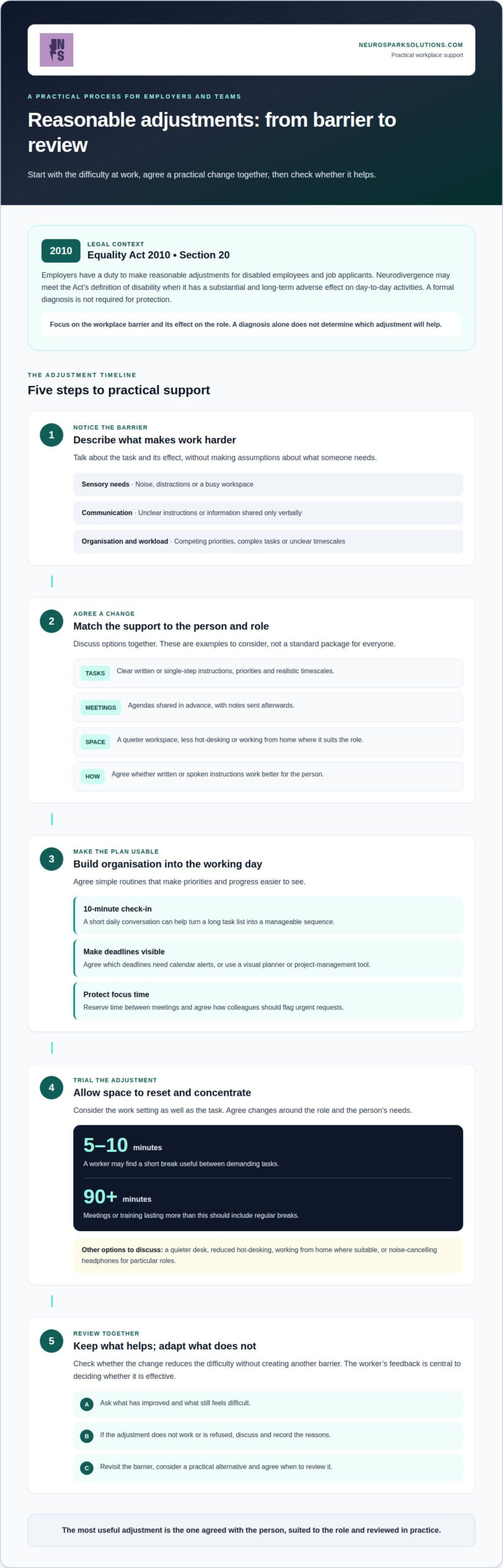
Reasonable adjustments for neurodivergent staff are practical changes to work, communication or the working environment that remove barriers and help someone do their job. Examples include clear written instructions, meeting agendas shared in advance, a quieter workspace or regular check-ins to prioritise tasks.
Under the Equality Act 2010, employers have a duty to make reasonable adjustments for disabled employees and job applicants, with section 20 setting out that duty according to the UK legislation register. Neurodivergence may meet the Act’s definition of disability when it has a substantial and long-term adverse effect on day-to-day activities, and a formal diagnosis isn’t required for protection, according to the Equality and Human Rights Commission.
The right adjustments depend on the individual and their role. Listening, agreeing practical support and reviewing how it works can make a real difference. You can use this guidance to understand how legal protections apply and find practical ways to support organisation, time management and inclusion at work.
Key Takeaways
- You can change how work is organised, communicated or carried out through adjustments. The most useful options reflect your needs and role.
- Understand how Equality Act protections may apply to you, and why you don’t always need a formal diagnosis to seek support.
- Make your priorities easier to manage with clear instructions, agreed check-ins and practical ways to keep track of tasks.
- Build inclusion into your everyday working practices by listening, trialling changes and reviewing whether they help.
1. What are reasonable adjustments?
A reasonable adjustment is a practical change to remove a work barrier linked to a disability or health condition. According to the UK legislation register, employers must make adjustments so workers with disabilities or physical or mental health conditions are not substantially disadvantaged at work. A worker’s diagnosis alone does not determine which change will help; the barrier and the effect on their role matter.
Examples in different settings show how changes can fit the task. At school, a pupil might receive written instructions alongside spoken ones. In healthcare, a staff member handling lengthy patient information might need extra processing time. At work, a neurodivergent employee could receive meeting agendas beforehand, clearer task priorities or a quieter place for focused work.
For sensory needs, consider a quieter workspace or less hot-desking. For communication, agree whether the person prefers written or spoken instructions. For organisation and workload, break a multi-step task into clear actions, set priorities and agree realistic timescales. These are options to discuss, not a standard package for everyone.
To assess an adjustment, identify the barrier, discuss the proposed change with the worker and consider the role, practical impact and resources involved. Trial the change, then review whether it reduces the difficulty without creating another barrier. The worker’s feedback is central to deciding whether it is effective. For more ideas, see this guide to workplace adjustments for neurodivergent employees.
If an adjustment is refused or does not work, discuss and record the reasons. Revisit the barrier together, consider a practical alternative and agree when to review it. Even an unsuccessful trial can clarify what support is needed.
Yes. Adjustments can apply during recruitment, meetings and remote or hybrid work. Employers might share interview questions in advance, send meeting agendas and notes, or consider working from home where it reduces distraction and suits the role.
Equipment or other support may also help. Access to Work may be able to help fund the support a person needs, and eligibility is determined by the UK Department for Work and Pensions. Workers can also suggest an Occupational Health referral to explore suitable changes. Access to Work support and coaching may help someone develop strategies for workplace demands.
2. Equality Act 2010 protections for employees and job applicants
The Equality Act 2010 places a legal duty on employers to make reasonable adjustments for disabled employees and job applicants. According to the UK legislation register, section 20 of the Equality Act 2010 sets out employers’ duty to make reasonable adjustments. If you’re an employer, the aim is to remove substantial disadvantage caused by workplace rules, recruitment arrangements or physical features.
Neurodivergence may meet the Act’s definition of disability when it has a substantial and long-term adverse effect on your ability to carry out normal day-to-day activities. The assessment concerns the effect on you, not assumptions based on a label. ADHD, autism, dyslexia and dyspraxia can affect people differently, so the support you need also varies.
A formal diagnosis isn’t a prerequisite. According to the Equality and Human Rights Commission, you don’t need a diagnosis to be considered disabled under the Equality Act 2010. Your employer may ask for information about a condition or its effects, but you can explain the workplace barrier and discuss possible changes without presenting a diagnosis first.
Protections can apply during recruitment. For example, if you’re an employer, you might adapt an interview process so a neurodivergent candidate can demonstrate their skills more comfortably, such as by providing questions in advance. Once employed, you can write to your manager, describe the difficulty and suggest an adjustment. A meeting can help you both agree what to trial.
If you’re an employer, consider each request in context, including the work involved, the adjustment’s practicality and its impact on the business. If a proposed change won’t work, discuss why and consider an alternative that addresses the same barrier. Record the agreed step and review its effect on your ability to do the role. This keeps the conversation focused on practical support, not assumptions.
Organisation and time management
Start with a shared plan for the day or week. A manager can set out tasks in priority order, with clear deadlines and single-step instructions for complex work. A short daily check-in can help a worker decide what needs attention first. For example, a 10-minute conversation can turn a long task list into a manageable sequence.
Calendars are most useful when they highlight what the worker needs to act on. Agree which deadlines need alerts, and use a visual planner or project-management tool to make progress visible. A manager can also help reserve focus time between meetings. If interruptions make a task difficult, agree how colleagues should flag urgent requests and when messages can wait.
Concentration can be affected by the work setting as well as the task. A quieter desk, reduced hot-desking or working from home may help some people limit distractions and sensory input. Noise-cancelling headphones may suit particular roles, too. Ask the worker what helps, including a colleague with autism, rather than assuming one approach works for everyone. Consider the effort involved in switching between tasks.
Plan reset time into the working day. A worker may find five- or ten-minute breaks useful between demanding tasks, while meetings or training lasting more than 90 minutes should include regular breaks. The timing and format can be agreed around the role, not treated as a reward for finishing work.
Review the plan together. Ask which deadlines were manageable, where interruptions affected concentration and whether calendar reminders helped. If an approach is not working, change one part at a time, such as moving a check-in or adjusting focus periods. Access to Work may be able to help fund specialist equipment or software, while workplace adjustments remain part of the employer’s support process. Regular individual conversations keep the focus on practical barriers, not assumptions about motivation.
4. Workplace accessibility and inclusion
An inclusive workplace makes it easier for people to contribute without having to hide how they work. Identify barriers in everyday routines, then agree changes with the person affected. Open-plan noise, for example, may make concentration difficult, while unclear expectations can complicate team communication. Focus on what affects the employee’s ability to do their role, not assumptions based on a diagnosis.
Practical changes might include a quieter desk, less hot-desking or agreed days working from home. Some employees may find noise-cancelling headphones or earplugs useful for reducing distractions; others might benefit from an anti-glare screen or a non-white computer background. Options should suit the work and the individual’s needs, rather than becoming fixed rules for everyone.
Inclusion also depends on how information is shared. Send meeting agendas in advance, provide written notes afterwards and agree whether email or spoken updates work best. If someone finds verbal instructions difficult to retain, follow the conversation with clear written actions. These changes can help colleagues take part and refer back to decisions without relying on memory alone.
Review each adjustment with the worker. Agree what barrier it should address, try the change and set a time to discuss its effect. Consider the workplace’s size and resources, the task involved and the practical impact on the business. If an adjustment does not help, use the worker’s feedback to consider another approach. A diagnosis is not the starting point for a useful conversation about barriers.
Access to Work can contribute support, but it does not replace an employer’s legal duty to make reasonable adjustments, according to the Department for Work and Pensions. Failing to make adjustments could amount to disability discrimination. Build accessibility into everyday decisions, from meeting formats to workspace arrangements, rather than waiting for a problem to escalate.
Explore workplace training to help managers turn inclusive intentions into practical everyday working habits.
Neuro-Sparks training solutions
Neuro-Sparks training solutions helps you turn adjustment discussions into practical workplace support for your employees and neurodivergent colleagues. Its workplace training and HR team support can help you and your managers understand barriers, communicate clearly and consider changes suited to each role. Assessments can help identify individual strengths and support needs, while neurodiversity coaching can help people develop approaches for everyday work demands.
This support can be useful when you are unsure where to start or when agreed changes need review. The focus is on understanding the person’s experience and finding practical ways to support inclusion, organisation and participation at work.
To explore support for your workplace, contact Neuro-Sparks training solutions.
Make the next step practical
Progress starts with a workplace barrier you can address together. Choose a change that matters to the person, agree how to put it into practice, then make time to review it. This keeps reasonable adjustments for neurodivergent staff connected to real tasks and experiences, rather than treating inclusion as a policy exercise.
If you are unsure how to move from discussion to action, Neuro-Sparks training solutions offers workplace training, assessments and HR team support. Its training is delivered by a CEO who is TAP Accredited and holds a PG Cert in Neurodiversity, bringing specialist knowledge to practical workplace conversations.
You don’t need every answer before starting a conversation. Contact Neuro-Sparks training solutions to discuss a practical next step for your workplace.
Frequently Asked Questions
What are reasonable adjustments?
Reasonable adjustments are changes that reduce a work-related disadvantage, shaped by the person’s needs and duties. For example, someone might need extra time to review and edit a document before submission. Another adjustment could be a phased return after time away from work, with hours increased gradually to suit the employee’s circumstances.
What reasonable adjustments can UK employers make for neurodivergent staff?
Possible adjustments include flexible arrival times or weekly hours when a role does not depend on a fixed start time. An employer might also agree a phased return after an employee becomes disabled, using flexible hours or part-time working. The practical option depends on the job’s essential tasks and what would help the employee carry them out.
What are UK employers’ legal duties under the Equality Act 2010 to make reasonable adjustments?
Employers should consider whether a proposed change is practical in their circumstances, taking account of their resources, the work involved and the impact on the business. Consider each request on its individual merits rather than dismissing it automatically because it differs from the usual approach. If one option is impractical, discussing an alternative keeps the focus on the barrier.
How can an employee request workplace adjustments for ADHD, autism, dyslexia or another neurodivergence?
Prepare for the conversation by noting when a work task becomes difficult and what would make it more manageable. For example, explain that unexpected verbal changes make it hard to keep track of priorities, then suggest receiving urgent updates by email or Teams. Agree how you and your manager will communicate about the change and when you will review its effect.
Who pays for reasonable adjustments, and can Access to Work provide funding?
Access to Work may be able to help fund support for eligible needs, such as travel, specialist equipment or software. Workers can apply, and support is considered individually. Treat it as a possible source of additional assistance, not a replacement for discussing workplace changes with your employer. Funding is not guaranteed, so do not rely on it before a decision.
What are examples of reasonable adjustments for neurodivergent staff in different jobs?
For someone who needs time to check detailed written work, an agreed review period before submission may help. A worker whose role involves frequent changes could receive urgent updates through an agreed channel, such as email or Teams. Someone returning after becoming disabled may benefit from a phased return with flexible hours. Each option should suit both the role and the person.