


A neurodiversity workplace assessment is not a test of whether someone is “neurodivergent enough”. It looks at how a person’s role, working environment and communication practices affect their day-to-day work, then identifies practical ways to reduce barriers and make strengths easier to use. This might include changes to task planning, written instructions, sensory demands or workplace communication.
You may know that an employee is finding parts of work difficult but be unsure which changes would help. A formal diagnosis isn’t required to explore their needs, preferences and working conditions. The assessment should focus on the person’s experience, rather than assumptions about a diagnosis or a particular way of thinking.
This guide explains what a neurodiversity workplace assessment examines, how it can connect workplace demands with an employee’s strengths and challenges, and how its findings can inform tailored support. It also covers whether an employee needs a formal diagnosis before their workplace needs and possible adjustments can be discussed.
Key Takeaways
- An employee can discuss workplace support without a formal diagnosis; focus the conversation on what helps them do their job.
- Look beyond individual tasks to spot barriers in communication, the work environment and everyday processes.
- A useful assessment connects role demands with an employee’s strengths and support needs, then turns findings into practical recommendations.
- Clear agreements about report access and follow-up help make support more useful and easier to review.
Do employees need a formal diagnosis?
No, UK employers aren’t required to commission one specific workplace assessment for every neurodivergent employee. The legal duty concerns reasonable adjustments when a disabled employee faces substantial disadvantage.
Support for diagnosed and self-identified employees
Support should respond to the employee, not just a label. Someone with an ADHD diagnosis might find written priorities helpful, while a self-identified autistic colleague may prefer advance notice of changes. Ask which parts of work create friction, what already helps and which strengths they would like to use more. This keeps the conversation practical and connected to the role.
Workplace barriers rather than diagnosis
A useful assessment examines the work itself, including instructions, meetings and changing priorities. If verbal instructions are difficult to retain, for example, written follow-up may help. The employee and manager can discuss the barrier, agree a suitable adjustment and review how it works. This avoids assuming what someone needs based on ADHD, autism or another form of neurodivergence.
UK legislation (The National Archives) identifies the Equality Act 2010 as relevant to neurodiversity-related conditions and reasonable adjustments. According to the Equality and Human Rights Commission, a worker doesn’t need a diagnosis to be considered disabled under the Equality Act 2010. UK legislation (The National Archives) says employers must make reasonable adjustments when a disabled employee is placed at a substantial disadvantage.
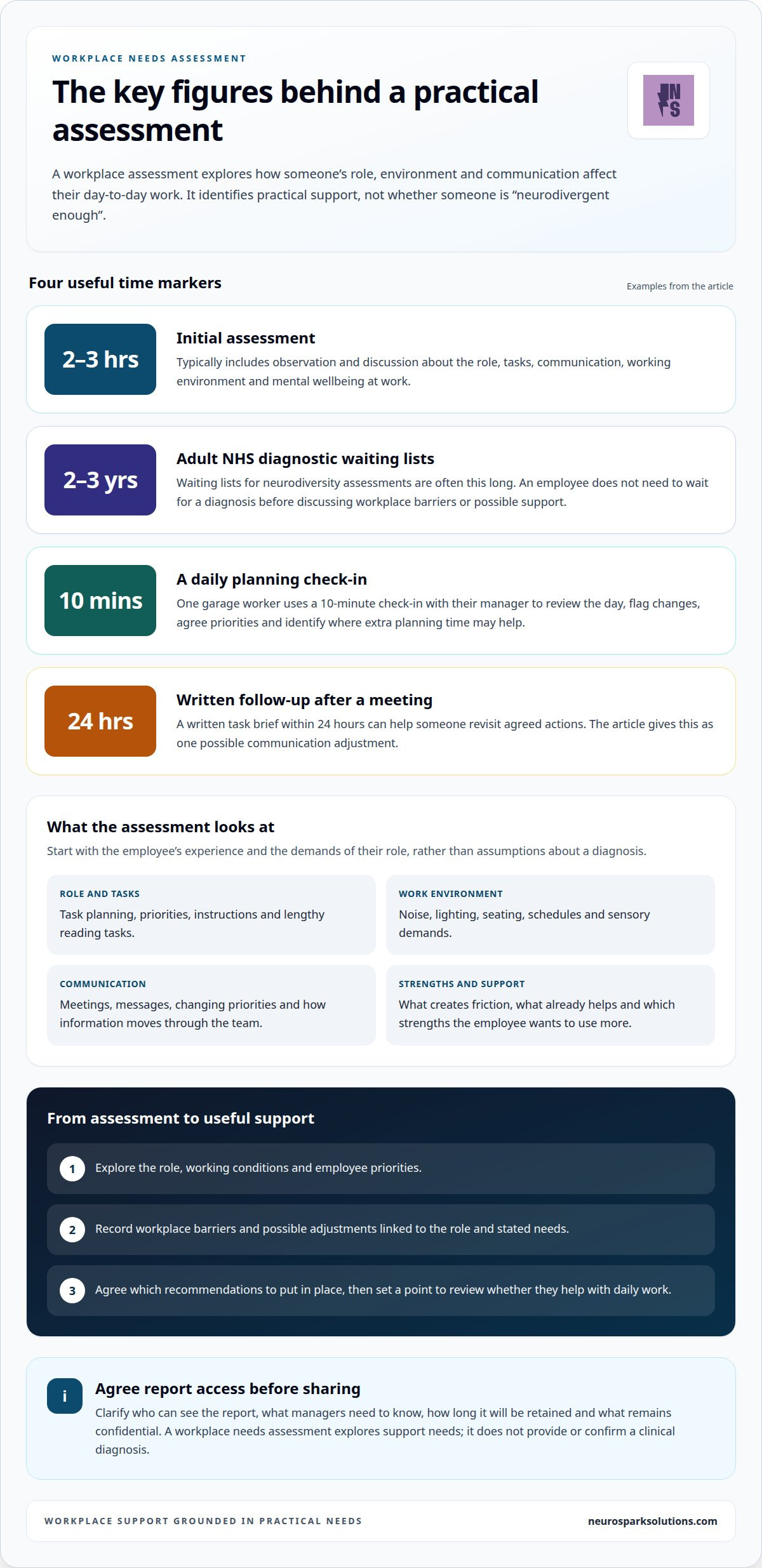
ADHD and autism diagnostic assessments are a separate process from reviewing workplace needs. Adult NHS waiting lists for neurodiversity assessments are often 2-3 years. An employee doesn’t need to wait for a diagnostic assessment before discussing workplace barriers or possible support.
Occupational health may help employers consider suitable adjustments. The focus remains on the employee’s working conditions, needs and strengths, whether they have a diagnosis or identify as neurodivergent.
Identifying organisational, environmental and communication barriers
A workplace assessment considers how everyday conditions affect someone’s work. It may identify excessive noise, bright lighting, close seating, unpredictable schedules, complex instructions or lengthy reading tasks. These barriers can affect focus, task completion and confidence. The assessor may also consider how information moves through the team, including meetings, messages and changes to priorities.
Organisational design matters because one employee’s difficulties may point to a wider process issue. Unclear ownership of tasks, for example, can leave priorities open to interpretation. A strategic approach looks at team routines and workplace communication, not only individual adjustments. It can reveal where clearer roles, predictable processes or accessible instructions could support more employees. Practical guidance helps managers turn neuroinclusive principles into everyday practice. For broader guidance on HR support for neurodiversity through adjustments and inclusion, consider how inclusive practices can support employees across recruitment, onboarding and day-to-day work.
For organisation and time management, strategies can include visual planners, reminders, smaller tasks and regular check-ins. A garage worker with dyspraxia and ADHD uses a 10-minute daily check-in with their manager to review the day’s plan. This gives both people a clear point to flag changes, agree priorities and identify where extra planning time may help.
Sensory needs vary. Noise-cancelling headphones, ear defenders, screen filters or a quiet private space may reduce sensory overload. Advance warning of workplace changes can make a busy day easier to plan. For someone who finds movement helpful, a standing desk or regular work breaks may support concentration. Any strategy should address a specific barrier and reflect the employee’s preferences.
Communication adjustments can include reading or writing software, talking through written information, extra time or clear step-by-step instructions. A written task brief within 24 hours of a meeting can help someone revisit agreed actions. Assessors should record the barrier, the proposed adjustment and how the team will review its effect. Practical workplace neurodiversity guidance can help turn findings into workable team strategies.
What is a workplace needs assessment?
A workplace support needs assessment explores how a role and its working conditions affect an employee’s ability to work. It identifies practical support rather than providing a formal clinical diagnosis.
Assessment referral and report process
A workplace neurodiversity assessment can be carried out by an assessor with relevant expertise in workplace needs. The role is to explore job demands and support needs, not to diagnose dyslexia, ADHD or autism. The referral should explain the work-related concerns and the employee’s priorities. Before the assessment, agree who will receive the report and what information managers need.
Consultation, report and aftercare
The initial assessment typically takes 2-3 hours, including observation and discussion. The consultation can explore tasks, communication, the work environment and the employee’s mental wellbeing at work. Unlike a clinical diagnosis, it does not identify or confirm a condition. Instead, the report sets out barriers and possible adjustments, with recommendations linked to the employee’s role and stated needs.
Agree how the report will be used before sharing sensitive details. Clarify who can see it, what managers need to know, how long it will be retained and what remains confidential. Once the report is ready, the employee and manager can discuss which recommendations to implement. Set a review point to consider whether the adjustments are helping with daily work.
In-person and online assessment options
Where appropriate, an in-person assessment can include observing the employee in their usual work setting. This may help the assessor understand how noise, task changes or communication affect a specific role. An online consultation allows discussion without the assessor being physically present. Either way, the employee’s examples and role details help ground recommendations in real working conditions.
Choose the format around the assessment’s purpose and the information needed. For example, an employee who finds written instructions difficult can describe when this affects their work. The assessor can then discuss practical changes and record them in the report. A workplace assessment can inform reasonable adjustments, but it does not itself establish Equality Act status.
Assessment of role demands, strengths, challenges and work environment
A useful assessment connects the employee’s responsibilities with the conditions around them. It considers where tasks, communication or workplace routines create challenges, and where the person’s strengths support good work. The assessment should be tailored to the role and the information needed, rather than following one fixed format.
ADHD, autism, dyslexia and dyspraxia can all be part of someone’s work experience, but they don’t determine what that person needs or prefers. For example, one employee may find task-switching or prioritising difficult, while another may benefit from more accessible written information or predictable routines. These are individual possibilities, not assumptions: recommendations should reflect the employee’s experience and job demands.
The assessor can explore how work is planned, assigned and reviewed. They may consider whether instructions are clear, deadlines manageable and feedback provided in a useful format. They can also discuss strengths the employee wants to use more often. Someone who spots detail quickly, for example, might thrive with focused checking tasks if competing interruptions are managed.
Stress, absence and changes in performance can indicate where work feels difficult, but they don’t explain the cause on their own. A structured discussion with the employee can connect specific pressures to possible changes. Recommendations might address task planning, communication or the physical environment. Managers and employees can then agree which adjustments to implement and how to review their effect.
Access to Work support can help employees explore funding for workplace support. Its role is separate from the assessment’s recommendations, which describe support needs in the context of someone’s job. For guidance on applying assessment findings to employee needs, explore tailored Access to Work support.
Neuro-Sparks training solutions: Workplace training
Neuro-Sparks training solutions can help turn workplace assessment findings into practical support. Its assessments explore employee needs, while workplace training helps managers understand how to put recommendations into practice. This can be useful when agreed adjustments need to fit everyday team routines, or when HR teams want support in responding consistently to neurodivergent employees.
For an employee who may benefit from additional workplace support, Access to Work support can help clarify possible next steps. The right option depends on the needs identified and the support required, not a diagnosis alone. Bring the assessment findings and questions about implementation to start a focused conversation.
To discuss workplace support, contact Neuro-Sparks training solutions.
Put practical support into motion
Progress comes from making support part of how work is planned, not treating it as a separate conversation. Use a neurodiversity workplace assessment to agree what happens next, who will take the lead and when to revisit the plan. Assigning an owner to each action helps connect good intentions with everyday work.
Neuro-Sparks training solutions brings practical neurodiversity expertise to conversations about workplace needs. Its team can help you consider how to move from a report to an approach that works for the employee and the organisation. Keep the employee involved as plans develop, so support remains relevant if responsibilities or working conditions change.
If you’re ready to explore the next step, contact Neuro-Sparks training solutions. Start with the workplace question you’re trying to resolve, then plan what comes next with care and confidence.
Frequently Asked Questions
How long does the process take?
The appointment is only one part of the overall process. The time from arranging an assessment to acting on its recommendations can vary with role complexity, scheduling and how quickly workplace discussions happen. Distinguish the assessor’s meeting from the wider decision-making timeline. The employer and employee can agree who will coordinate follow-up so recommendations don’t stall after the assessment.
What sort of adjustments are likely to be recommended?
There’s no standard package of adjustments. Recommendations should reflect the employee’s priorities and the essential demands of their role. A helpful report can distinguish changes that are straightforward to try from those that need wider planning. It should also explain what each recommendation is intended to address, helping managers assess its relevance and decide how to put it into practice.
What is a neurodiversity workplace assessment in the UK?
A workplace assessment is a work-focused review that helps an employee and employer consider what support could make the role more workable. Its purpose is practical, not to judge someone’s capability or establish a medical label. The findings can give both parties a shared basis for discussing support in relation to the job, rather than relying on general assumptions about a condition.
What happens during a neurodiversity workplace assessment?
The assessor invites the employee to describe how different parts of the role feel in practice, including what goes smoothly and where effort increases. The conversation can clarify which work demands matter most to the employee and keep the outcome grounded in their own account. The employee can also discuss whether proposed recommendations reflect their experience before workplace decisions are made.
Can Access to Work fund a neurodiversity workplace assessment?
Access to Work may be able to help fund workplace support, but funding for a particular assessment isn’t automatic. The Department for Work and Pensions decides eligibility and what support may be funded. Keep the scheme’s decision separate from the employer’s consideration of workplace needs. That allows discussions about practical support to continue without assuming a funding outcome.
What reasonable adjustments can employers make after an assessment?
Employers can agree adjustments with the employee and make the decision clear to anyone responsible for putting it into effect. Record the agreed change, who will action it and how the employee can raise concerns if it isn’t working as intended. Managers should share only the information colleagues need to carry out the arrangement, while respecting the employee’s privacy.