


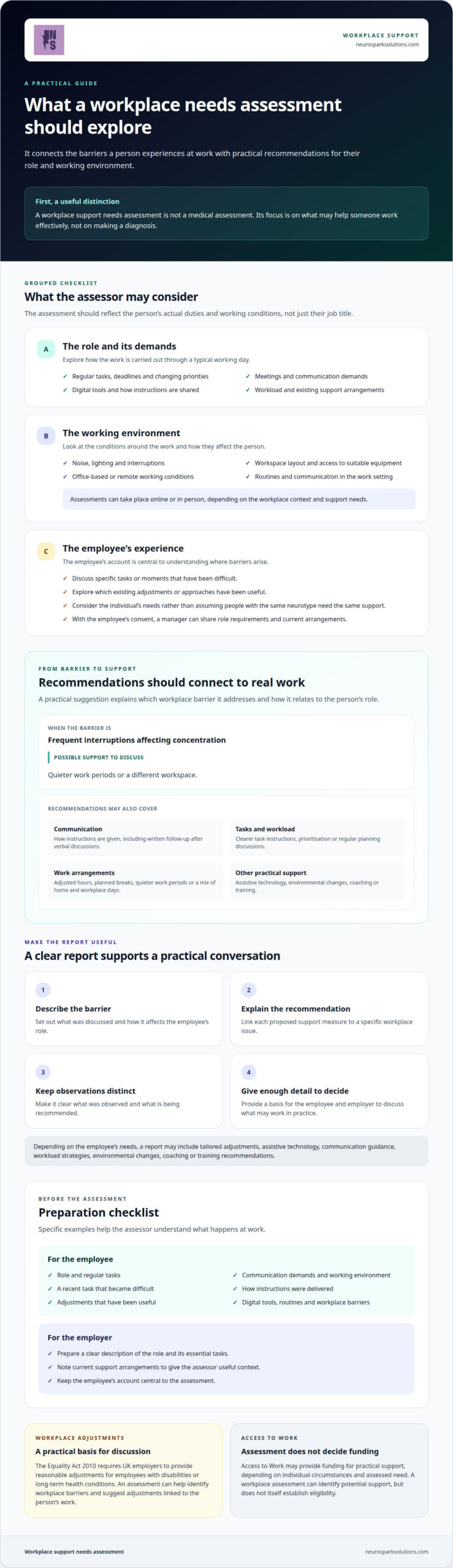
A workplace support needs assessment is not a medical assessment. It looks at how someone’s role and working environment create barriers, then identifies practical recommendations. The focus is on what may help the person work effectively, not on making a diagnosis.
That distinction can bring clarity when a person’s needs and the demands of their job aren’t lining up. According to The National Archives, the Equality Act 2010 requires UK employers to provide reasonable adjustments for employees with disabilities or long-term health conditions. An assessment can help translate day-to-day barriers into support that makes sense for the person and their work. For examples of reasonable adjustments for neurodivergent staff, including communication and workplace changes, see this practical guide. Explore workplace adjustments for neurodivergent employees for guidance on identifying barriers and agreeing practical changes.
This guide explains how an assessment considers a role, its tasks, communication demands and working environment, and what a useful report may contain. It also covers possible recommendations, from adjustments and tools to training or changes to working arrangements, and explains how a workplace needs assessment differs from occupational health. Use this information to understand what to expect and when an assessment could help.
Key Takeaways
- See how a workplace assessment connects day-to-day barriers with practical support for a person’s role.
- Learn which parts of a job, working environment and communication needs an assessor may explore.
- Understand what makes a report useful for turning observations into clear recommendations.
- Get a clearer sense of how workplace assessments differ from occupational health and where each may fit.
What is a Workplace Needs Assessment?
A workplace support needs assessment examines how a person’s work and environment affect them. Assessments can take place remotely or in person, depending on the employee’s role and support needs.
Tailored workplace adjustments
The assessment links specific barriers to practical recommendations. For example, if frequent interruptions make it difficult to concentrate, recommendations might include quieter work periods or a different workspace. A useful report explains how each adjustment relates to the person’s role instead of offering a generic list. This helps managers see what could change in daily tasks, communication or routines.
Support for neurodivergent employees
For a neurodivergent employee, recommendations might cover how instructions are given, how tasks are prioritised or how meetings are structured. One person may find written follow-up after verbal discussions helpful; another may need fewer competing demands. The assessment should explore the individual’s experience rather than assume that everyone with the same neurotype needs identical support. A diagnosis is not required to start this practical conversation. Guidance on workplace adjustments for neurodivergent employees can also help identify changes to communication, tasks and the working environment.
Reasonable adjustments under the Equality Act 2010
According to The National Archives, the Equality Act 2010 requires UK employers to provide reasonable adjustments for employees with disabilities or long-term health conditions. An assessment can help identify barriers and suggest adjustments linked to the person’s work. Recommendations may include changes to equipment, working arrangements, communication or the physical environment. The report should make clear what obstacle each recommendation addresses, giving the employee and employer a practical basis for discussion.
Finding a provider in the UK
You can find workplace needs assessment providers across the UK, including services that carry out assessments remotely. Employers or employees can request an assessment at different stages, such as during induction, after an absence or when a role changes. Look for a process that explores the employee’s actual duties and working conditions. A useful assessment focuses on workplace barriers and support recommendations, rather than diagnosing a health condition.
Assessment of job roles and work environments
An employer or employee can request an assessment in the UK. It explores how the person’s role and working environment affect their work, including tasks, communication demands, workload and existing support.
The assessor considers the practical details of the job, not just its title. They may discuss deadlines, changing tasks, meetings, digital tools and how instructions are shared. A private conversation with the employee helps identify where barriers arise during a typical working day. With the employee’s consent, a manager can also share information about role requirements and current arrangements.
The working environment matters too. An assessment may consider noise, lighting, interruptions, workspace layout and access to suitable equipment. A busy open-plan office, for example, may make concentration harder, while remote work can bring different challenges around communication or routine. Recommendations may cover assistive technology, environmental changes, reasonable adjustments or coaching. Assessments can take place online or in person, depending on the workplace context and support needs.
Access to Work is a UK Government scheme. The Department for Work and Pensions says it can help people with a physical or mental health condition or disability get or stay in work. It may provide funding for practical support, depending on individual circumstances and assessed need. An assessment can identify potential support, but it doesn’t itself establish eligibility for funding.
Flexible working arrangements may also be considered when they address a specific barrier. Options might include adjusted hours, planned breaks, quieter work periods or a mix of home and workplace days. The assessor should link each suggestion to the role and the employee’s needs, making the recommendations practical to discuss and apply.
Assessment and report requirements
A useful report turns the employee’s account and workplace context into clear, practical recommendations. It should give the employee and employer enough detail to decide what action to take.
Required report content
A structured report describes the barriers discussed and explains how they affect the employee’s role. It may set out tailored adjustments, assistive technology, communication guidance, workload strategies, environmental changes, coaching or training recommendations. Each recommendation is more useful when it links a specific workplace issue to a proposed support measure.
Look for enough detail to support a practical conversation, rather than a list of suggestions. If changing priorities are difficult, for example, the report might recommend clearer task instructions or regular planning discussions. It should distinguish observations from recommendations and explain how each suggested action relates to the employee’s work. This gives the organisation a clearer basis for deciding next steps.
Information a provider may ask you to prepare for an assessment
Before the assessment, the employee may be asked about their role, regular tasks, communication demands and working environment. Specific examples can help: a recent task that became difficult, how instructions were delivered, or which existing adjustment has been useful. The provider may also ask about digital tools, routines and barriers at work.
An employer can prepare a clear description of the role, its essential tasks and current support arrangements. This gives the assessor useful context without replacing the employee’s account. The employee and employer can also identify questions for the assessment, such as how to make meetings or changing deadlines more manageable.
There is no single fixed timeframe for receiving a report. The schedule depends on factors such as the assessment’s complexity, the information needed from the employee and employer, and whether the assessor needs to understand the working environment directly. Sharing relevant role details and examples early can help keep the process focused.
After the assessment, the report should make the proposed actions clear to everyone involved. For example, a recommendation about assistive technology should link the tool to a work task or barrier. Clear wording helps the employee, manager and HR team discuss how support could fit existing routines and any relevant scheme.
Difference between a workplace needs assessment and occupational health
A workplace needs assessment focuses on barriers in a person’s role and working environment. Occupational health considers how health relates to work, such as someone’s ability to carry out particular duties. The purposes differ: a needs assessment develops practical workplace recommendations, while occupational health provides health-related advice to inform work decisions.
For example, an employee may find it difficult to focus in a noisy office. A workplace needs assessment can explore that barrier and suggest adjustments, such as a quieter workspace or clearer communication. Occupational health may instead consider how a health condition affects the employee’s ability to work and advise on suitable duties or support. The processes address different questions.
The evidence considered also differs. A workplace needs assessment draws on the employee’s experience, job tasks, working environment and existing support, then connects those details to recommendations the organisation can discuss and implement. Occupational health advice is based on relevant health information and the relationship between a person’s health and their work. Neither process should be treated as a diagnosis of neurodivergence.
Choose the process that matches the decision you need to make. If the main question is how to reduce barriers, such as unclear instructions or sensory demands, a workplace needs assessment can identify practical adjustments. If the concern is how a health issue affects someone’s ability to work, occupational health may provide relevant advice. Where both questions matter, the findings can inform different parts of the workplace plan.
Keep the employee’s perspective central in either process. A recommendation is useful only if it addresses the person’s actual tasks and can be put into practice. For example, a change to meeting formats should reflect how meetings work in that role, rather than rely on a generic assumption about disability. Recording agreed actions clearly helps managers and employees understand what happens next.
If practical workplace barriers need closer assessment, explore workplace assessments to identify relevant support and adjustments.
Neuro-Sparks training solutions: Workplace training
Neuro-Sparks training solutions provides assessments, workplace training, HR team support and Access to Work support. If an assessment identifies practical changes, workplace training can help managers understand different working styles. HR team support can help your organisation consider how recommendations fit its workplace practices.
These services can help when a team needs more than a written report, such as practical guidance on putting support into action or building shared understanding. Access to Work support can also help you explore assistance through the scheme.
For a practical conversation about workplace support needs, contact Neuro-Sparks training solutions.
Turn recommendations into practical progress
A workplace support needs assessment can be the starting point for better day-to-day working, rather than a report that goes unused. Agreeing who will take each action and how the employee can share what is working keeps support connected to real workplace needs. Thoughtful changes can help people and teams work well together.
Neuro-Sparks training solutions provides assessments, workplace training and HR team support to help organisations put support into practice. Its CEO delivers training and is TAP Accredited, with a PG Cert in Neurodiversity. This can help managers and colleagues build practical understanding alongside workplace changes.
When you’re ready to discuss a suitable next step, contact Neuro-Sparks training solutions. Progress can begin with a clear conversation about what would help.
Frequently Asked Questions
Are assessments confidential?
At the outset, ask how your information will be recorded, who will see the report and what may be shared with your employer. You can also discuss whether the report should focus on workplace recommendations rather than personal background. Agreeing these boundaries in advance helps you understand how information will be handled and feel prepared to talk about your work.
Is this a diagnostic assessment?
No. A workplace needs assessment cannot confirm or rule out a diagnosis, and its findings should not be treated as clinical evidence about a condition. The assessor considers workplace support; diagnosis is a separate clinical process. If you already have relevant diagnostic information, you can discuss whether it helps explain your experience at work. The assessment is not a test of eligibility for a diagnosis.
Why are they useful?
An assessment can give an employee and manager a shared basis for planning next steps. They might agree who will communicate a change to working arrangements and how they will review whether it is helping. This makes follow-through easier to discuss, rather than leaving the employee to raise the same concern repeatedly or managers unsure who is responsible.
What is a workplace support needs assessment?
A workplace support needs assessment is a structured way to understand support needs in the context of someone’s work. It considers the employee’s perspective alongside the organisation’s working arrangements, keeping the discussion focused on the person’s role. It can help when a workplace concern needs a considered response rather than an informal assumption about what might help.
How can a provider help you arrange a workplace needs assessment through Access to Work?
Access to Work support can guide you through assistance connected with the scheme and help relate workplace needs to practical support. Neuro-Sparks training solutions provides this support alongside assessments. The provider offers guidance, but the UK Department for Work and Pensions determines eligibility. You can discuss your work situation and the support you are seeking to understand what assistance may be relevant.
What happens during a workplace support needs assessment?
The assessment is a conversation, not an exam. Explain what you want the assessor to understand, including which parts of your working day are going well and where you would like more support. The assessor may ask follow-up questions to clarify your experience. You can also raise any recommendations that might be difficult to put into practice in your role.