



The most useful HR support for neurodiversity begins with a simple shift: neurodiversity describes the natural variation in how people think, process information and experience the world, rather than a problem to correct, and each person’s strengths and support needs are individual. You may already know that reasonable adjustments matter, but general workplace support doesn’t replace adjustments tailored to an employee’s needs; an open, respectful approach gives people space to explain what helps without pressure to disclose personal information. You’ll learn how adjustments can remove practical barriers, how HR, managers and colleagues each contribute to an inclusive workplace, and how clear communication, thoughtful role design and recognising different strengths can help people contribute with confidence while supporting the team as a whole.
Key Takeaways
- See how inclusive recruitment, onboarding and day-to-day management can help neurodivergent people show their skills and progress at work.
- Learn how practical training can help managers and people teams respond with greater confidence and consistency.
- Explore how recognising individual strengths, alongside addressing workplace challenges, can support colleagues and team culture.
- Understand how screening and Access to Work support can help identify useful next steps without treating screening as a diagnosis.
Reasonable adjustments
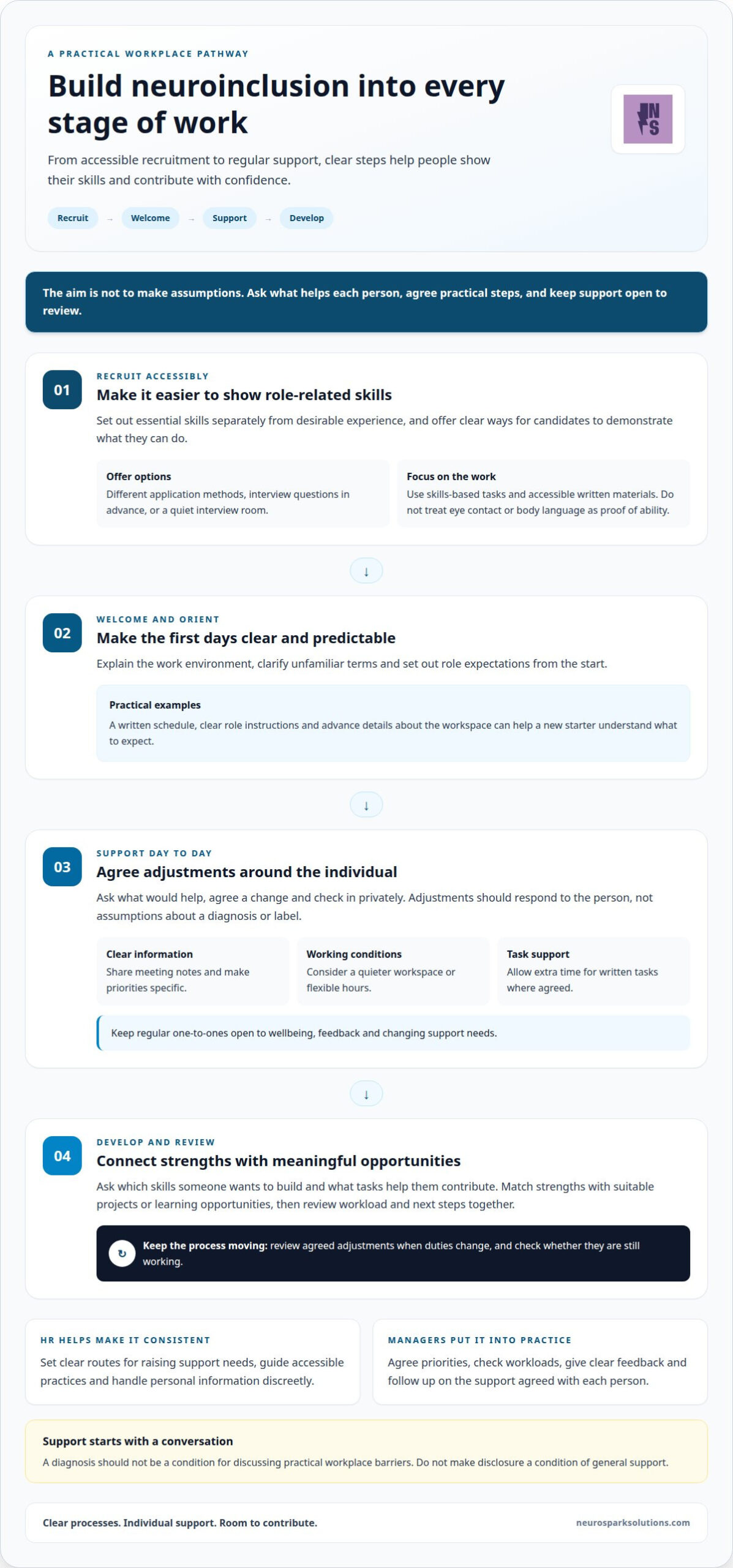
The Equality Act 2010 is relevant to employers’ legal obligations for supporting neurodivergent employees in the UK, according to UK legislation. Reasonable adjustments remove or reduce workplace barriers, while recognising each person’s strengths. For an autistic new starter, onboarding could include a written schedule, clear role instructions and advance details about the workspace. These steps clarify expectations from day one.
Adjustments should reflect the individual, not assumptions about autism or dyslexia. A manager might share meeting notes, allow extra time for written tasks, offer a quieter workspace or agree flexible hours. Ask what would help, agree on a change and record only necessary information with consent. Don’t make disclosure a condition of general support: quiet spaces and clear instructions can benefit everyone.
Putting adjustments into practice can stall when managers feel unsure, requests are delayed or HR processes require employees to repeat personal details. Regular private check-ins help review whether an adjustment still works as duties change. Access to Work may be able to help fund support for eligible employees, with eligibility determined by the UK Department for Work and Pensions. It complements, rather than replaces, an employer’s responsibilities. Without appropriate support, barriers may remain and an employer may fail to meet its legal duties to make reasonable adjustments.
How do workplace roles support neuroinclusion?
In the UK, HR helps employers turn inclusion commitments into consistent processes. It can guide recruiters and managers on accessible practices and reasonable adjustments, and establish clear routes for raising support needs and handling personal information discreetly. A diagnosis should not be a condition for discussing practical workplace barriers. These steps clarify responsibilities across teams. For more guidance, see neurodiversity policies for the workplace.
At recruitment, clear job descriptions distinguish essential skills from desirable experience. Applicants can be offered different application methods or interview questions in advance. A quiet interview room can reduce distractions. Skills-based assessments, such as a practical task, focus on role requirements rather than interview style. Accessible written materials can help a candidate with dyslexia demonstrate relevant skills. Train interviewers not to treat eye contact or body language as proof of ability.
After appointment, onboarding can explain the work environment and clarify unfamiliar terms. Managers can agree on priorities, check workloads and ask which development opportunities interest each person. Regular one-to-ones create space to discuss wellbeing, feedback and changing support needs. Involving neurodivergent employees in projects that match their skills can support progression and retention. HR can review recruitment, onboarding and promotion processes together, then address barriers at each stage.
Manager training and support
For UK employees, the Equality Act 2010 is relevant to discrimination and support, according to UK legislation. HR support for neurodiversity helps people teams turn that context into clear workplace processes. A policy can explain how employees raise concerns, who handles requests and how agreed actions are recorded. Managers also need practical guidance on applying policies consistently, including when an employee asks for changes to their working arrangements.
Training builds confidence through practical workplace examples. Managers can practise responding when an employee finds verbal instructions difficult or needs clearer priorities. HR professionals can develop skills for guiding conversations about needs and adjustments. Talent acquisition teams can review recruitment practices, while learning and development staff can make training accessible. Wellbeing teams can learn how to signpost workplace support without assumptions about someone’s diagnosis or preferences.
Strong HR support for neurodiversity connects learning with everyday practice. Managers, for example, can practise setting specific expectations, checking understanding and giving actionable feedback. HR can provide a framework for recording agreed actions and reviewing whether they help. A neurodiversity policy should explain the organisation’s commitment, responsibilities and available support. Regular team discussions can reveal where daily practice doesn’t match policy and clarify what needs to change.
Focusing on neurodivergent colleagues’ strengths
Strengths vary between neurodivergent colleagues, so avoid assumptions based on a label. In a one-to-one, ask which tasks feel engaging, where someone brings expertise and what helps them focus. A colleague might enjoy spotting patterns in data, developing detailed processes or generating fresh ideas. Use their answers to shape responsibilities and identify opportunities, rather than relying on stereotypes in interviews or appraisals.
Build on those strengths while addressing practical challenges. If switching between tasks interrupts concentration, a manager could agree on protected focus time and clear priorities. If verbal discussions move too quickly, share key points in writing. These strategies support the individual without lowering expectations. They can also help colleagues understand different working preferences and strengthen everyday workplace culture.
Retention grows when contribution leads to meaningful development. In regular conversations, ask which skills an employee wants to build, then connect them with a suitable project or learning opportunity. Someone who excels at detailed analysis, for example, could contribute to a process review and present recommendations in a format that works for them. Recognise the outcome, discuss next steps and review workload together. Valuing strengths while responding to challenges creates clearer routes for people to contribute and progress.
Neurodivergent screening and identifying support needs
Screening can offer a structured way to explore traits that may shape someone’s experience at work. It may prompt useful conversations about focus, planning, reading, communication or sensory preferences. Make it optional and handle it privately, with the employee choosing what to share. The aim is to understand possible barriers and helpful working conditions, not to label someone or judge their capability.
A short dyslexia quiz, for example, can identify possible traits but cannot diagnose dyslexia. Screening results need context: a person may have similar difficulties for different reasons, and no single result explains their full working style. Use findings as a starting point, then ask which tasks feel difficult and what changes could help. Depending on the person’s needs, options might include clear written instructions or extra time to review information.
Keep the process respectful: explain why screening is offered, who will see the results and how they may inform support. Don’t make screening a condition for discussing workplace needs. The employee and manager can agree on a practical change, note the outcome and revisit it when work routines change. This keeps decisions grounded in lived experience rather than assumptions drawn from a score.
Access to Work support
Access to Work support can help an employee explore practical assistance related to their job. Neurodivergence may affect how someone manages communication, planning or workplace demands, but support needs vary. A focused discussion can connect the person’s day-to-day responsibilities with the help they want to explore, giving the employee and employer a clearer picture of relevant options.
For example, an employee who finds it difficult to organise competing tasks could explain which parts of their role create friction. Their employer can describe the work environment and current ways of working. This context helps consider support in relation to the employee’s actual responsibilities, rather than assumptions based on a diagnosis. Access to Work support can include practical guidance to explore suitable workplace support.
Eligibility for Access to Work is determined by the UK Department for Work and Pensions. An employee can involve their employer in discussions about what might help, sharing only the information they choose to share. Clear communication can help both parties understand possible next steps and how support could fit the role. The aim is a workable arrangement that reflects the person’s needs and the demands of their work.
Neuro-Sparks training solutions
Neuro-Sparks training solutions helps organisations put neuroinclusion into practice. Neurodiversity Workplace Training can build shared understanding among teams and managers, while HR team support can help align internal processes. Assessments can inform conversations about an employee’s working needs. Together, these services offer practical ways to strengthen HR support for neurodiversity across your organisation.
Neurodivergent Coaching gives individuals personalised guidance to explore their work preferences and professional goals. It can help someone reflect on which approaches suit their role and how to communicate those preferences at work. Training and individual support address different needs: one builds understanding across a team, while the other focuses on a person’s experience. This can help an organisation respond more thoughtfully than a single general discussion.
Consider support when your team needs help turning inclusion aims into practical decisions or an employee would value focused coaching. HR support for neurodiversity can be tailored to the needs you want to address. The team’s CEO is TAP Accredited and holds a PG Cert in Neurodiversity. Contact Neuro-Sparks training solutions to discuss the support that could work for your workplace.
Frequently asked questions
What is neurodiversity?
Neurodiversity describes the range of ways people’s minds work. It isn’t a diagnosis or a fixed set of traits. When discussing a person, use the language they prefer, such as “autistic person” or “person with autism”. Respectful wording keeps conversations focused on the individual rather than assumptions attached to a label.
How do different roles in the workplace contribute to neuroinclusion?
Neuroinclusion works best when responsibilities connect rather than sit in separate policies. HR can set a clear process, a manager can put agreed support into practice, and a senior leader can make time for teams to follow it. A named point of contact also helps employees know where to raise questions when their needs or role change.
What does neurodiversity mean in the workplace?
In practice, consider whether workplace systems measure the results of someone’s work or favour one particular way of working. A team, for instance, can assess the quality of a completed project without treating quick verbal responses in meetings as the only sign of contribution. Clear expectations help people understand what success means in their role.
How can an HR support provider help with reasonable adjustments for neurodivergent staff?
An HR support provider can help a people team make its approach more consistent across departments. Support may include policy development, advice for HR professionals and an assessment to identify suitable adjustments. This can be useful when managers respond differently to similar requests. The employee’s perspective remains essential when deciding whether a proposed change fits their work.
How can an HR support provider help managers support neurodivergent employees during recruitment and onboarding?
Workplace training can help managers consider the candidate and new-starter experience as one connected process. Teams can review whether candidates know what to expect at each stage, then make sure new starters understand who to approach with questions. HR support can help managers build consistent practices across teams, rather than leaving each new starter to work out informal procedures alone.
What workplace adjustments are commonly helpful for autism, ADHD, dyslexia and dyspraxia?
Possible options include advance notice of changes for an autistic employee, agreed task milestones for someone with ADHD, accessible digital text for a colleague with dyslexia, or breaking a complex practical process into clear stages for someone with dyspraxia. These are prompts for discussion, not rules based on a diagnosis. Ask what fits the person’s tasks and preferences, then review the arrangement together.